Western Australia now has a date for the biggest change to its criminal and civil courts in living memory. On 18 September 2027, the Evidence Act 1906 — the law that has governed what a jury is allowed to hear in every WA trial for 120 years — will be repealed outright and replaced.
The proclamation setting that date was made by the Governor on 15 September 2026 and published on the state's legislation website the following day. It is a single page. The law it switches on runs to 384 pages and 411 sections.
The Evidence Act 2025 passed Parliament and received assent on 25 September 2025, but almost none of it has been in force since. Only the definitions in Part 1, one review provision, and a single division of consequential amendments are live today. Everything that matters — how witnesses give evidence, what juries are told, what police can put before a court, what a journalist can be forced to reveal — waits for 2027.
That two-year gap is deliberate. Judges, magistrates, prosecutors, defence lawyers, police and court staff all have to be retrained, and rules of court rewritten, before the switch is thrown.
Here is what is actually in it.
Sexual offence and family violence trials change the most
The clearest shift is in what a judge is permitted to tell a jury.
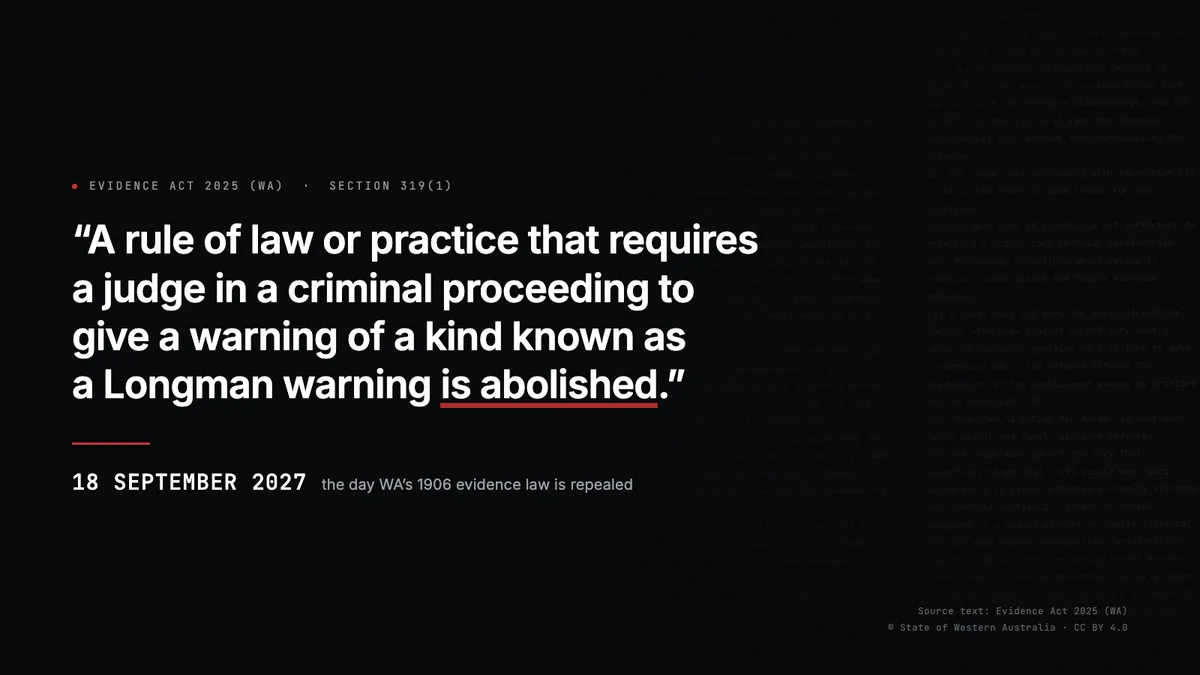
The Longman warning is abolished. Section 319(1) says, in terms: "A rule of law or practice that requires a judge in a criminal proceeding to give a warning of a kind known as a Longman warning is abolished." That warning — named after a 1989 High Court case — has for decades required judges in delayed-complaint cases to caution juries about the danger of convicting. It is gone.
Judges will be barred from suggesting a late complaint damages a complainant's credibility. In sexual offence and family violence trials, section 320(2) prohibits a judge from warning, directing or "otherwise suggesting" that delay in complaining, or not complaining at all, affects credibility. There is one exception: the accused can ask for such a direction, and the court must be satisfied it is "justified in the particular circumstances of the case" (s 320(3)). Even then, the judge must not tell the jury it is "dangerous or unsafe to convict" or that the complainant's evidence should be "scrutinised with great care" (s 320(4)).
In their place comes a direction the judge must give. Section 321 requires a judge in those trials to tell the jury that "experience shows that … people may react differently to sexual offences or family violence … and there is no typical, proper or normal response"; that some people complain immediately, "others may not complain for some time and others may never make a complaint"; and that delay in complaining "is a common occurrence". The timing is mandatory too — where the judge expects such evidence, the direction must be given before that evidence is led, and may be given before any evidence at all.
Two related prohibitions sit alongside. Judges must not tell juries it is dangerous to act on uncorroborated evidence (s 315(2)), and must not suggest that children as a class are unreliable witnesses or that their evidence needs more careful scrutiny than an adult's (s 318(1)). A warning about a particular child is still possible, but only if a party asks and can point to something "other than solely the age of the child" (s 318(2)).
Each of these sections ends with the same saving clause: none of it affects a judge's other powers to warn or inform a jury. The prohibitions are aimed at specific, named warnings, not at judicial guidance generally.
Evidence of a defendant's past conduct gets easier to admit
In child sexual offence cases, section 114 presumes that evidence of an accused's "sexual interest … in children (even if the accused has not acted on the interest)" has significant probative value — whether or not that interest concerned a complainant in the case, "any other child or children generally".
A judge can rebut the presumption only "if it is satisfied that there are sufficient grounds to do so" (s 114(5)). And section 114(6) then removes from that assessment most of the arguments defence counsel would normally run — that the conduct was different, the circumstances different, the victim's age or sex different, the relationship different, that time had passed, that there was nothing "distinctive or unusual" — unless the court finds "exceptional circumstances".
Separately, section 110(5) provides that in weighing probative value, "it is not open to the court to have regard to the possibility that the evidence may be the result of collusion, concoction or contamination." The argument that multiple complainants have compared notes does not keep the evidence out; it becomes a question for the jury. Section 115(2) expressly contemplates evidence from two or more complainants being used to prove the accused did the act charged.
The balancing test for prosecution tendency evidence is that its probative value must "outweigh" the danger of unfair prejudice (s 118(2)) — not substantially outweigh it.
How complainants will give evidence
Parts 6 and 7 rebuild the machinery of giving evidence for people the Act treats as vulnerable.
Protection becomes automatic rather than applied for. A complainant in a sexual offence or family violence case, and any prosecution witness in an organised crime case, "must be treated as a special witness" under section 229(1) — no application, no need to demonstrate distress. So must a witness whose mental impairment affects their ability to give evidence.
There is a limit worth noting. For sexual offence and family violence charges, the automatic category applies only in a "superior court" — the Supreme, District or Family Court. A charge of the same kind heard in the Magistrates Court is not automatically covered, though the court can still declare a witness special under section 230, and regulations could extend the automatic list later.
Video link becomes the default, not the concession. For a special witness, giving evidence from a separate room over a video link is mandatory (s 277(1)(c)). It is mandatory for children too, whether or not they are special witnesses (s 277(1)(a)). A screen is the fallback only where the technology genuinely is not available and cannot reasonably be made available.
Evidence may be recorded long before trial. In a family violence case, a recording police make at the scene — with the person's consent and their spoken declaration that it is true — can serve as the whole of their evidence-in-chief (s 240). For someone who was a child when the offence occurred, a police video interview does the same job, however old they are by the time of trial (s 252). And under a pre-recording order, the entire evidence including cross-examination can be taken at a special hearing months ahead (ss 262–264), with the court required to weigh "the length of time until a trial is likely to be held".
The accused is never in the room. At a special hearing the accused cannot be present with the witness, and the court has no power to allow it (s 265(2)). They watch by video link.
An unrepresented accused cannot question certain witnesses at all. Section 57 imposes an absolute bar on a self-represented accused personally cross-examining a child, a sexual offence complainant, or — in organised crime cases — any prosecution witness. Questions go through the judge or a court-approved person who must repeat each one accurately. An adult can consent to being questioned directly; a child can never consent.
Intermediaries and ground rules. Where a complainant is a child under 10, or a child complainant in a sexual offence case, the court must request a professional assessment of whether they need a witness intermediary — and if it decides one is not needed in the second case, it must say why on the record (s 290). Where an intermediary is appointed, a ground rules hearing is mandatory (s 295(4)). At that hearing, before any questioning, the court can fix how long cross-examination runs, when breaks fall, and what questions may not be asked (s 294).
The evidence is not given twice. Recordings are admissible in "any related proceeding" — a retrial, a rehearing, an appeal. Recalling the witness requires the court's leave on a narrow test (s 271).
Throughout, the jury must be told that these arrangements are routine court practice and that no inference against the accused should be drawn from them. The defence may not tell a jury that the prosecution failed to use a recorded statement, nor comment on a witness declining an intermediary.
Importantly, a complainant can still choose the courtroom. A protection may be dispensed with only where the witness consents and the court is satisfied they understand and decided "freely and voluntarily" (s 311). The accused cannot apply to strip a protection away.
Counselling records
The Act carries a detailed regime restricting access to a sexual offence complainant's counselling records (ss 164–177). A "protected communication" covers what a complainant told a counsellor, what the counsellor said or wrote about them, and file notes, reports, observations and opinions — and it reaches doctors, psychologists and psychiatrists, because "counsels" includes a person who "advises, gives therapy to or treats" someone.
Nobody can disclose or demand these records in a criminal case without the court's leave, and a subpoena issued without leave "is of no effect" (s 166(4)). An application must be in writing, supported by affidavit, and filed at least 28 days before trial. It has to clear a paper gate before any hearing is even listed. The complainant, the counsellor, and anyone else who made the communication must be notified and can appear with their own lawyer. Leave is granted "if and only if" three conditions are all met: a legitimate forensic purpose, no other evidence to the same effect available, and the public interest favouring disclosure (s 169).
No confessional privilege in child sexual abuse cases
Section 200 provides that a person cannot refuse to give evidence on the ground that it would reveal a religious confession — its contents, or even that it was made — in a criminal proceeding for a sexual offence where the complainant was a child at the time, or a civil proceeding alleging child sexual abuse.
In those cases, WA law will give a priest no confessional seal. It is one of only two substantive sections in the privileges Part that carries no note identifying a source provision in either the old WA Act or the interstate uniform Acts.
Police interviews and confessions
Several rules tighten around what police bring to court.
An admission is inadmissible unless the court is satisfied it was not influenced by "violent, oppressive, inhuman or degrading conduct" or a threat of it (s 99). Beyond that, evidence of an admission is not admissible unless the circumstances "make it unlikely that the truth of the admission was adversely affected" (s 100(2)) — and in assessing that the court must weigh the person's "age, personality, race, culture, ethnicity, religion and education and any disability that the person has or appears to have".
Unsigned police notes of an oral admission are out. A document prepared by an official is not admissible to prove what a suspect said unless the suspect acknowledged it as a true record by signing, initialling or marking it (s 101). Recordings and their transcripts are exempt — so what is on tape is in, what is in a notebook is not.
Silence cannot be turned against a suspect: no unfavourable inference may be drawn from a failure to answer questions, and "inference" expressly includes an inference of consciousness of guilt or one going to credibility (s 104).
Identification evidence always comes with a mandatory judicial warning of "a special need for caution" and the reasons for it (s 135). Prosecution identifications made from police image sets are inadmissible outright if the records used suggest they are images of people in custody (s 134).
Journalists and their sources
The Act carries a source-protection privilege. Where a journalist has promised an informant anonymity, "neither the journalist nor the journalist's employer is compellable" to answer a question or produce a document that would reveal or enable identification of the source (s 180). It reaches subpoenas, discovery, interrogatories and notices to produce — not just the witness box (s 183) — and it applies to information given before the Act commences (s 394(4)).
A court can override it with an "exclusion order", but only if satisfied the public interest in disclosure outweighs both the likely harm to the source and "the public interest in the communication of facts and opinion to the public by the news media and, accordingly, in the ability of the news media to access sources of facts" (s 181(2)).
There is a significant qualification. Section 182 says a court "may" make an exclusion order where there was misconduct by the source or the journalist, and that "generally an exclusion order should be made" in five listed situations. Two are broad: where a public servant leaked information that could have been disclosed under the Public Interest Disclosure Act 2003 and was not, and where the information "could have been obtained by the journalist under the Freedom of Information Act 1992 or by other lawful means". Neither requires the leak to have caused harm. The court needs only "reasonable grounds" to find misconduct, and "misconduct" is defined broadly enough to include "inappropriate partiality".
The privilege protects identity only — not unpublished notes, footage or drafts — and, unlike the counselling regime, nothing in the division requires the journalist or the source to be notified before an exclusion order is sought.
Three things media will not be able to publish
The Act creates publication offences that fall directly on newsrooms, and in two of them liability attaches personally to proprietors, editors and publishers.
- Identifying an alleged sexual offence victim — or the school they attend — without a court's express permission: a fine of $5,000 for an individual and $25,000 for a body corporate (s 381). The provision covers newspapers, broadcasts and, on its terms, online and social publication. Permission is not retrospective: it does not excuse a breach that happened before it was given. There is a defence where the person gave written authorisation beforehand, was 18 or over, and was capable of making a reasonable judgment about it.
- Publishing a protected recording — a police interview, a recorded statement, or a recording of evidence given under a special procedure: up to 2 years' imprisonment or a $100,000 fine, and the Supreme Court can approve publication only in "exceptional circumstances" (s 306).
- Publishing a question the court disallowed as improper, or one for which leave was refused: a $6,000 fine, and the publisher "is taken to be in contempt" of the court as well — though not punishable twice for the same act (s 380).
Other changes worth knowing
Improper questioning becomes the judge's own duty. Section 50 requires a court to disallow a cross-examination question that is "unduly annoying, harassing, intimidating, offensive, oppressive, humiliating or repetitive", or put "in a manner or tone that is belittling, insulting or otherwise inappropriate", or that "has no basis other than a stereotype". The duty applies "whether or not an objection is made". But a failure to disallow does not make the answer inadmissible — so it creates no automatic appeal point.
The original document rule is abolished (s 61). The common law requirement to produce originals is replaced by a technology-neutral scheme in section 59, with an express route for material that only becomes readable when a device retrieves or collates it.
Coroners are inside the Act. The definition of "court" expressly includes the Coroner's Court of Western Australia, so the questioning rules and witness protections apply at inquests.
Family violence evidence in self-defence cases may bear on whether a person believed an act was necessary to defend themselves or another "from a harmful act, including a harmful act that was not imminent" (s 140).
Which cases it applies to
The changeover rule is in section 389, and it is simpler than it looks: from 18 September 2027 the new Act governs everything — except a hearing that had already started before that day, which finishes under the old Act, even if it runs on or is adjourned into 2028 or later.
The cut-off is the start of the hearing, not the start of the case and not the date of the alleged offence. A charge laid in 2024 with a trial listed for 2028 runs entirely on the new Act. A trial part-heard on 17 September 2027 finishes on the 1906 Act.
One gap is worth flagging: Part 11 contains no appeal or retrial provision at all. On the face of section 389, a retrial ordered after the changeover is a new hearing and runs under the new Act, whatever governed the first trial — but the Act does not say so expressly.
Part 12 amends 66 other Acts across 24 divisions, including the Criminal Procedure Act, the Restraining Orders Act and the Spent Convictions Act.
What is still missing
A substantial amount of this cannot operate until regulations exist that have not yet been made: the accreditation of witness intermediaries, the classes of police qualified to take recorded statements and conduct recorded interviews, and any additional categories of special witness. The witness intermediary service may also lawfully be made available "only for a proceeding in a specified area or areas" — so a complainant in a country town may not get one where a Perth complainant would.
Regulations made under the Act may themselves create offences carrying up to 12 months' imprisonment and a $100,000 fine.
Three reviews are already scheduled. The recorded statement provisions must be reviewed two years after they commence; the Act as a whole at five years and again at ten.
A note on what we can and cannot say
This article is based on a complete reading of the Act as passed, together with the commencement proclamation and the state's assent and commencement table. Every section number above can be checked against the official text on the WA legislation website.
One limitation is worth stating plainly. The Act's own note says it is a hybrid: "Parts of this Act are based on uniform evidence law provisions, as in force at 1 January 2025. Parts of this Act are based on provisions of the Evidence Act 1906." Most sections carry a footnote identifying the provision they descend from — but the Act nowhere sets out what the old law said. So while we can describe precisely what the new law does, we have avoided claiming that any particular rule is brand new to Western Australia unless the text itself makes that clear, as section 319 does when it abolishes the Longman warning by name.
Main image: Perth Supreme Court building by eGuide Travel, via Wikimedia Commons, CC BY 2.0. Cropped and colour-graded.
Comments