
In a suburban Perth garden, a single domestic cat wiped out the resident population of Ctenotus fallens — a striped skink native to the Western Australian coastal plain. The cat was not feral. It was somebody's pet, doing exactly what cats do.
That case, documented in the peer-reviewed review We need to worry about Bella and Charlie in CSIRO's Wildlife Research, has become a kind of shorthand among urban ecologists for what is unfolding on streets across this city — and it is only the case that got measured.
The numbers behind the cat flap
Research led by Professor Sarah Legge (ANU), Professor John Woinarski (Charles Darwin University) and Professor Chris Dickman (University of Sydney) compiled 66 separate studies of pet-cat predation. Their headline finding: each roaming pet cat in Australia kills an average of 186 animals a year. Of those, 110 are native — roughly 40 reptiles, 38 birds and 32 mammals per cat, every year.
Per square kilometre, suburban pet cats kill 30 to 50 times more animals than feral cats do in the bush, because there are simply more of them, packed tighter, with prey concentrated around our gardens.
Combined with feral cats, the total annual kill across Australia sits at roughly 1.7 billion native animals. The federal government's Threatened Species Recovery Hub describes cats as a factor in the decline of 85% of Australia's threatened mammals, more than 50% of threatened birds and reptiles, and 40% of threatened frogs.
What Perth is losing
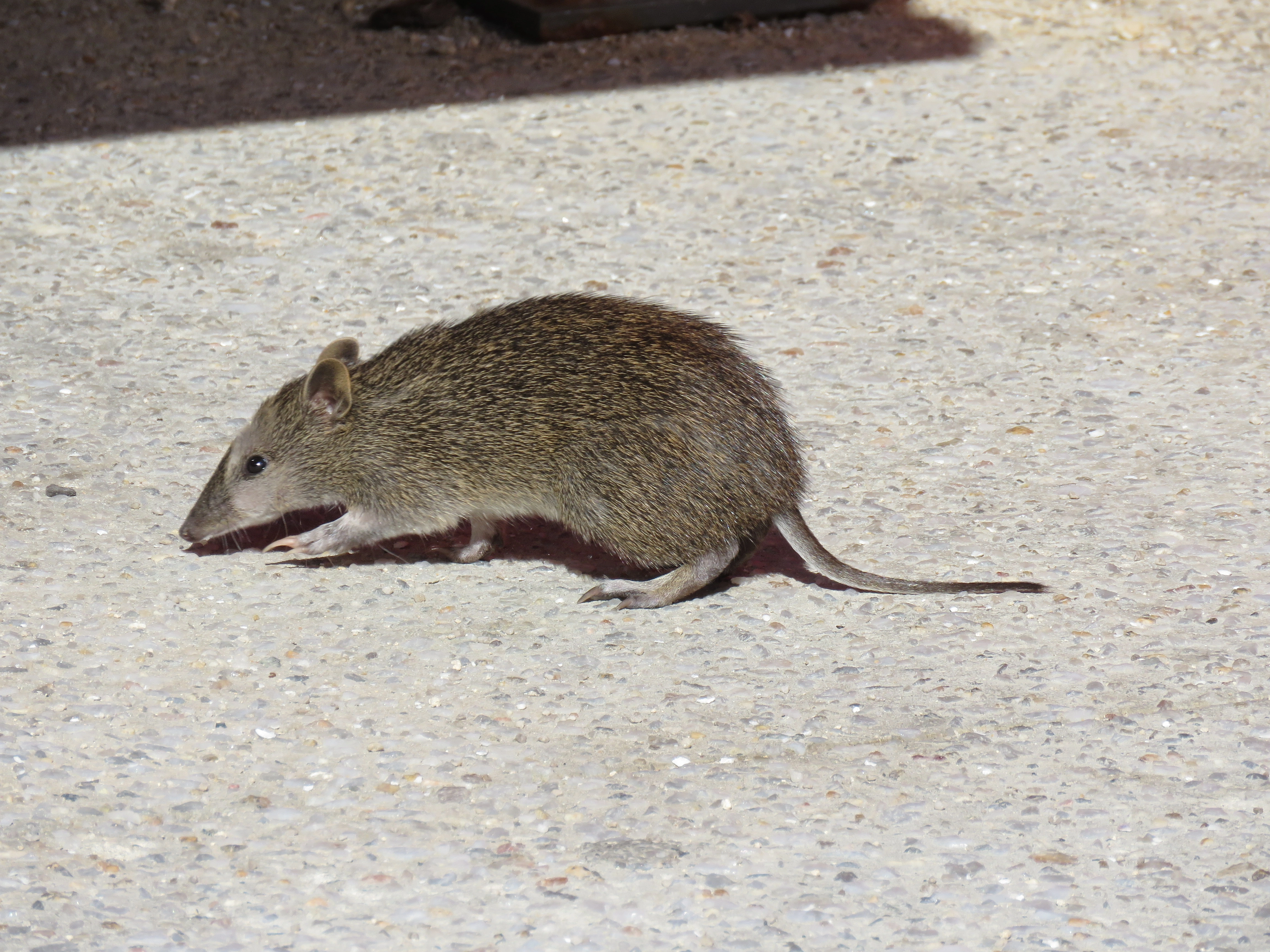
Perth is one of very few capital cities in the world that still has wild native marsupials inside its suburbs. The quenda (Isoodon fusciventer) — a small, pointy-faced bandicoot that fossicks through leaf litter at dawn and dusk — is the last of them in town. As a ground-dweller, the quenda is exposed to cat predation in a way few other backyard species are; the WA Department of Biodiversity, Conservation and Attractions lists cats and foxes as primary threats, alongside vehicle strike.
The western ringtail possum, found from Perth south to Albany, is now listed as critically endangered. The species has disappeared from at least 80% of its pre-European range, with cat and fox predation among the documented drivers of decline.
Smaller fauna fare worst of all. A separate metropolitan-Perth study across 57 sites found that pet cats were a significant factor shaping passerine bird community composition in the city. Reptiles — the most numerous category in Legge's national figures — rarely make it into the news at all.
Why the local cat hits harder than the bush cat
Feral cats in remote WA reserves are the focus of the state's Western Shield aerial-baiting program and the WA Feral Cat Working Group. The Cook Government recently committed an additional $2.7 million to feral-cat operations in priority reserves including Fitzgerald River, Cape Le Grand, Stirling Range, Lake Magenta and Dragon Rocks. A bush-roaming feral cat is estimated to kill more than 700 small animals a year.
But the per-cat number obscures the bigger issue: density. Australia has an estimated 3.8 million pet cats, the majority of them in cities. An inner Perth suburb can hold dozens of pet cats per square kilometre, all concentrated in the same patches of remnant bushland that quendas, ringtails and skinks are trying to use. Each one of those cats kills less than a feral cat — but together, per hectare, they kill many times more.
Containment: where the law is heading
Western Australia regulates cats through the Cat Act 2011, which from six months of age requires every pet cat to be microchipped, sterilised and registered with the local government. A cat caught in public without its registration tag earns the owner a $200 on-the-spot fine. Containment, however, has historically been left to councils — and most have not legislated it.
That is changing.
- City of Fremantle already mandates 24-hour cat containment in new housing developments.
- City of Joondalup formally promotes 24-hour containment.
- City of South Perth's Cats Local Law 2024, in force since December 2024 and amended in February 2026, sets numerical limits on cats per household, controls nuisance cats and prohibits cats in specified areas.
- City of Perth has no formal curfew but encourages best-practice ownership.
The Cook Labor Government has confirmed it will amend the Cat Act in 2026 to give local governments clear power to make and enforce cat-containment laws. That bill, when it lands, will be the first time the state has explicitly backed councils to legislate the cat flap.
What changes if your cat stays inside
If every Perth pet cat were kept indoors — or in a "catio" run, or contained behind cat-proof fencing — the per-cat 186 figure would fall close to zero. That single change is the highest-leverage piece of conservation work available to a Perth household. The dawn-and-dusk peak of native fauna activity, which is when most predation occurs, is also when most cats want to be outside. A curfew during those hours alone makes a substantial dent.
None of this is a moral case against cats. It is a case against the cat flap left open after dark. The quenda in your verge will not write you a thank-you card; she will simply still be there in the morning.
Header photo: Quenda (Isoodon fusciventer) at North Coogee, July 2024, by Calistemon / Wikimedia Commons, used under CC BY-SA 4.0.
_in_North_Coogee,_Western_Australia,_July_2024_01.jpg)
Sources and further reading
- Legge S., Woinarski J., Dickman C. et al. We need to worry about Bella and Charlie: the impacts of pet cats on Australian wildlife, Wildlife Research, CSIRO Publishing.
- National Environmental Science Program — Threatened Species Recovery Hub. The impact of pet cats on Australian wildlife.
- WA Feral Cat Working Group. What do we know about cats and their impacts?
- WA Department of Biodiversity, Conservation and Attractions. WA's new strategy to crack down on feral cats and Living with Quenda.
- WA Department of Local Government, Sport and Cultural Industries. Laws for responsible cat owners.
- City of South Perth. Cats Local Law 2024 and 2025 Amendment.
- UNSW Newsroom (January 2026). Yes, feral cats and foxes really have driven many Australian mammals to extinction.
- Australian Wildlife Conservancy. The feral catastrophe.
Comments (3)