
In three weeks Perth hosts what its organisers call Australia's largest land defence industry event. Israel's state-owned missile maker is on the exhibitor list. Protesters are marching from Yagan Square. And for ten days the river edge of the CBD becomes a zone where police can demand your name without suspicion, search you, ban you, and move you on for three days.
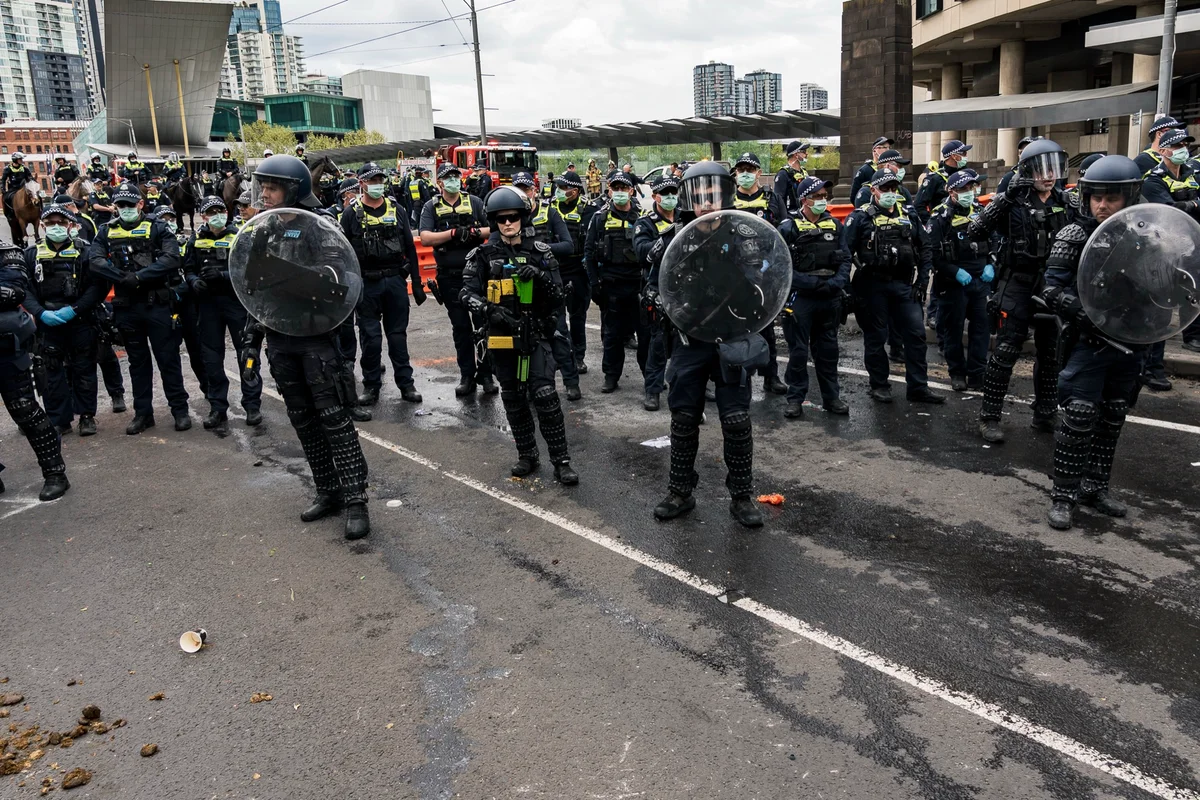
Victoria Police public order officers outside the Land Forces expo in Melbourne on the first day of the show, 11 September 2024. WA Police say they do not want a repeat. Photo: Matt Hrkac, CC BY 4.0, resized.

What is Land Forces?
Land Forces is a trade show for the land-warfare industry. Armoured vehicles, artillery, missiles, drones, small arms, armour, battlefield software and the companies that build and sustain them, sold to governments and their armies. It is not open to the public. Visitor registration is trade-only and closes on 1 October.
It is run by the AMDA Foundation, the not-for-profit that also stages the Avalon airshow and the Indo Pacific maritime expo, "in support of the Australian Army". The Army is the major supporter. It is normally held every two years and moves between cities: Adelaide in 2016 and 2018, Brisbane in 2021 (a COVID-delayed edition) and again in 2022, Melbourne in 2024. This is the first time it has come west.
Land Forces 2026 runs from Tuesday 6 to Thursday 8 October at the Perth Convention and Exhibition Centre. The program is built around the Chief of Army Symposium, a speaker series called The Hub (sponsored by the US contractor Amentum) and an innovation "pitchfest". AMDA calls it "Australia's largest land defence industry event"; the state government calls it "Australia's largest land-based defence industry exhibition".
How big is it? The WA government has given two different numbers. When it introduced its special-powers bill in June it said "up to 10,000 domestic and international delegates". In the statement it issued on Wednesday announcing the laws had passed, it said "up to 20,000". Defence West, the state's defence industry office, expects "more than 10,000 attendees" and hundreds of local companies exhibiting. The official exhibitor list runs from a Perth 3D-printer shop to global weapons primes.
Who is coming: Rafael is confirmed
Everything Perth checked AMDA's exhibitor directory on 16 September. Filtered by country, it returns one Israeli exhibitor: Rafael Advanced Defense Systems, stand 6A12, registered as an Israeli manufacturer.
Rafael is owned by the State of Israel. It makes the Spike anti-tank missile family, the Iron Dome interceptor and the Trophy active-protection system fitted to Israeli tanks. Its products are in service with the Israeli military in Gaza. When Greens MLC Sophie McNeill was pressing the government in the Legislative Council last week on the list of items protesters will be banned from carrying into the zone, her summary was: "Glue is banned, but Spike missiles are apparently okay."
McNeill also told the Council that Elbit Systems, Israel's largest arms company, "will be represented at Land Forces". Everything Perth could not find Elbit on the exhibitor directory at the time of writing.
Whether Israeli companies should be there at all is a live question elsewhere. In June 2024 the French government barred Israeli firms from Eurosatory, the Paris arms fair; a commercial court overturned the ban on the eve of the show, by which point Rafael had said it would not exhibit anyway. In June this year France tried again, barring official Israeli participation and a national pavilion and limiting Israeli exhibitors to air- and missile-defence equipment. Israel's Defence Ministry called it "a shameful decision". Australia has no such restriction. Asked about it in the Council, the minister handling the bill, Matthew Swinbourn, said who enters the country is a matter for the Commonwealth, and once a company is lawfully here it is "entitled to the protection of the law".
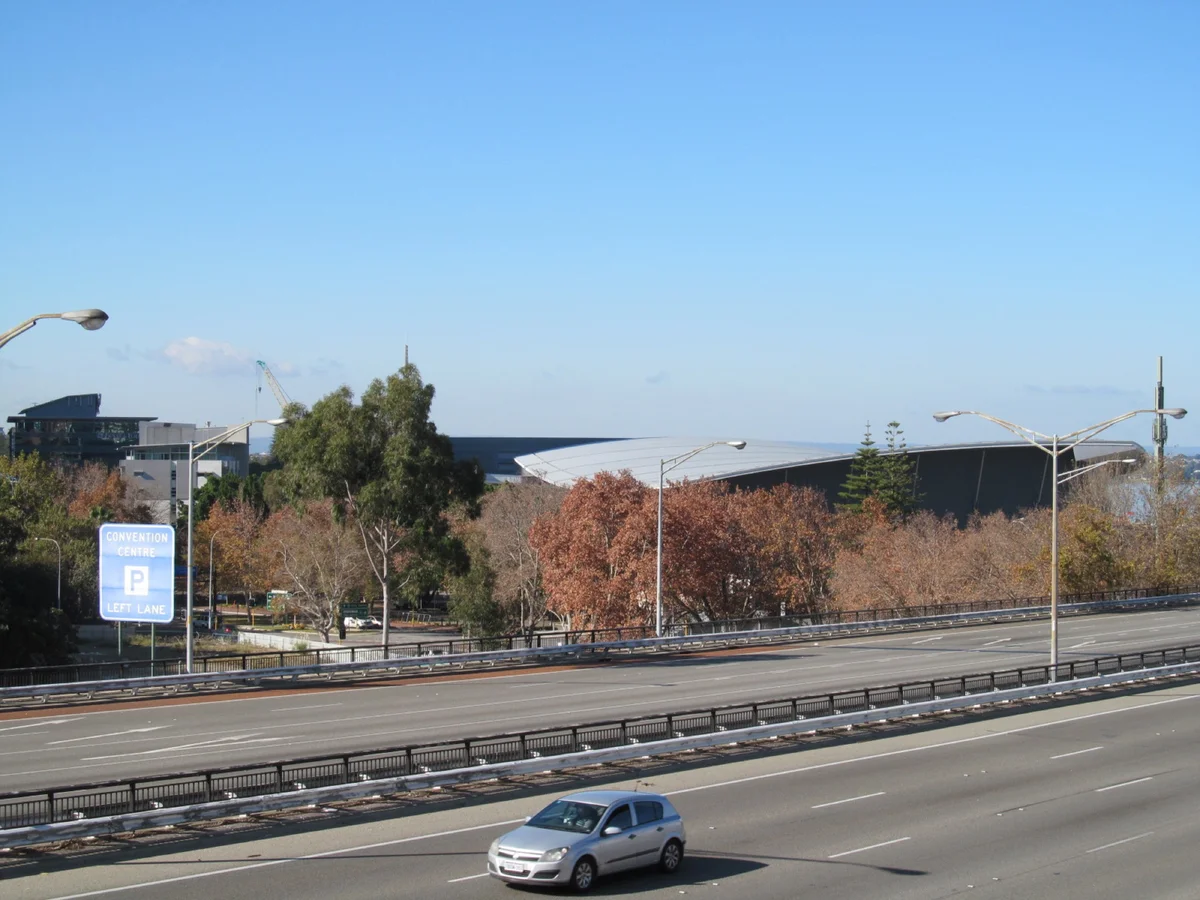
The Perth Convention and Exhibition Centre from the Mount Street footbridge, photographed in 2013. For ten days in October the block around it, including what are now Elizabeth Quay station and bus station, becomes a "Land Forces security area". Photo: Orderinchaos, CC BY-SA 3.0, resized.

The genocide in Gaza
None of this can be understood without Gaza. The reason Land Forces attracts protests of a kind no other trade show in Australia does is that the companies on the floor supply the Israeli military, and the Israeli military has, since October 2023, been carrying out a genocide against the Palestinian people of Gaza.
That is not a slogan. It is the conclusion reached, one after another, by the UN's own commission of inquiry, by the two largest international human rights organisations, by Israel's leading human rights groups and by the world's association of genocide scholars. The one court that can rule on it has not yet reached the question, but has already ordered Israel to stop:
- The International Court of Justice, in January 2024, found South Africa's case arguable enough to order emergency measures: it held that Palestinians in Gaza have a plausible right to be protected from genocide, and ordered Israel to prevent genocidal acts and let aid in. It has not yet ruled on whether genocide has occurred; South Africa's case continues.
- Amnesty International, in December 2024, after a year-long investigation: Israel is committing genocide.
- Human Rights Watch, in December 2024: Israel's deliberate deprivation of water amounts to extermination and acts of genocide.
- B'Tselem and Physicians for Human Rights Israel, the country's own leading human rights organisations, in two reports released together on 28 July 2025, B'Tselem's titled "Our Genocide".
- The International Association of Genocide Scholars, by resolution in August 2025: Israel's conduct meets the legal definition in the Genocide Convention.
- The United Nations Commission of Inquiry, on 16 September 2025, found Israel had committed four of the five acts of genocide defined by the 1948 Convention: killing, causing serious bodily or mental harm, inflicting conditions of life calculated to destroy the group, and preventing births. Its chair at the time, the former UN High Commissioner for Human Rights Navi Pillay, said responsibility "lies with Israeli authorities at the highest echelons who have orchestrated a genocidal campaign for almost two years now with the specific intent to destroy the Palestinian group in Gaza". The commission named Prime Minister Benjamin Netanyahu, President Isaac Herzog and former defence minister Yoav Gallant as having incited it, and found Israel had disregarded the ICJ's orders. Pillay and her fellow commissioners resigned late last year; the commission was reconstituted in January.
Israel rejects all of these findings.
The numbers, as of 15 September: Gaza's Health Ministry counts 73,789 people killed and 174,798 injured. A ceasefire has nominally held since 10 October last year; the ministry says 1,375 people have been killed since, in what it describes as continuing Israeli violations of the ceasefire. Independent researchers say the ministry's count is a floor, not a ceiling. A population survey published in The Lancet Global Health this year estimated 75,200 violent deaths to early January 2025 alone, a central figure with a range of 63,600 to 86,800, against about 49,000 recorded by the ministry over the same period, implying an undercount of roughly a third; women, children and people over 64 made up 56 per cent of those deaths. The survey's methods have since been challenged in correspondence in the same journal, which its authors dispute.
The UN commission urged states to stop transferring to Israel arms and equipment "that may be used for the commission of genocidal acts". Canberra insists Australia has not exported weapons to Israel since the war began. The ABC has reported that dozens of military export permits to Israel approved before the war stayed active through it, and in April three Palestinian human rights groups went to the Federal Court to force the Defence Minister to produce the permit records, citing Australian-made F-35 components. Campaigners also point to the Future Fund's holdings in Elbit, Lockheed Martin and Palantir. Those arguments arrive in Perth on 6 October with the delegates.
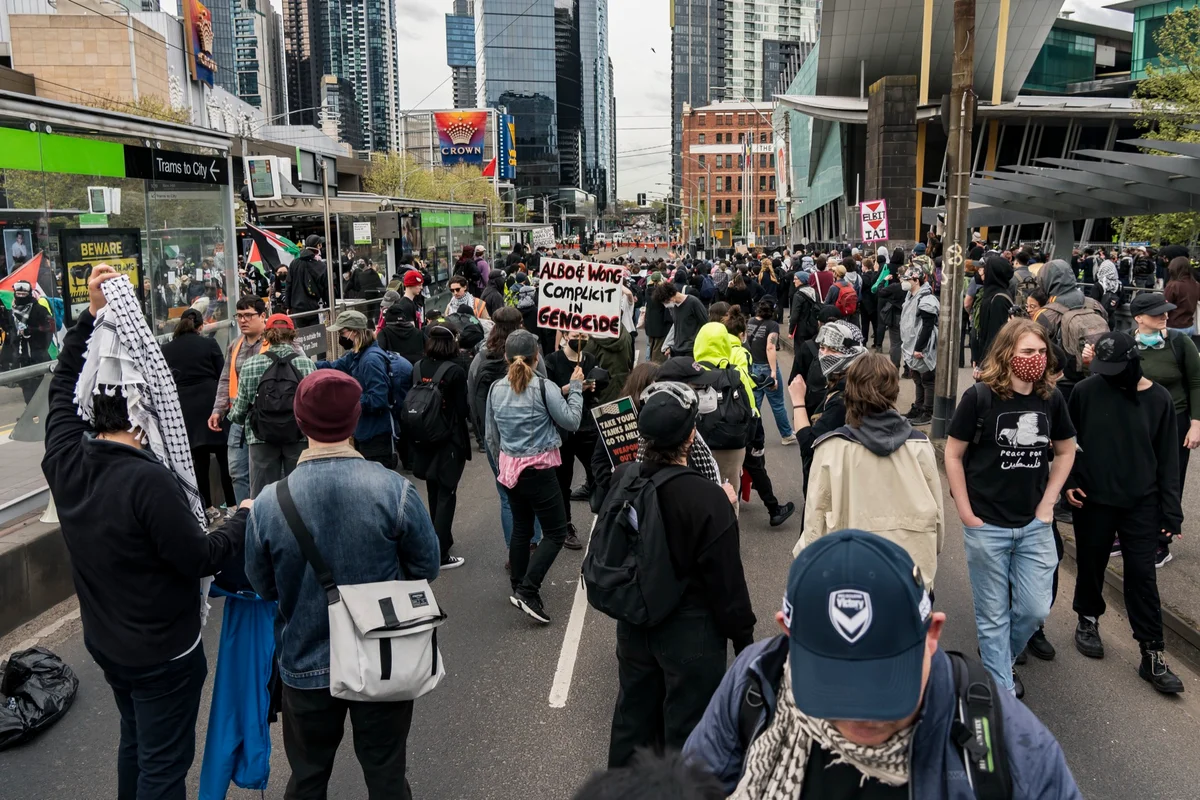
The first day of the Melbourne expo, 11 September 2024. Gaza, not the arms trade in the abstract, is what has turned Land Forces into a flashpoint. Photo: Matt Hrkac, CC BY 2.0, resized.
.jpg)
Why this lands hardest in Perth
Gaza is the dominant reason people will march. But the older objection to the arms trade itself, and a set of Perth-specific grievances, sit underneath it.
Nuclear-powered US and UK submarines begin rotating through HMAS Stirling at Garden Island next year under Submarine Rotational Force West. The Commonwealth is building a consolidated defence precinct at Henderson, where Army landing craft are already under construction. The state government wants WA to be the western anchor of a rearming Australia; its own strategy has defence "set to become" the state's second-largest industry after mining, and a Defence West Bill is on the Assembly's notice paper now. The Commonwealth's own estimate of the AUKUS submarine program is up to $368 billion over three decades.
To the groups organising against Land Forces, all of that is one project: the expo, the submarines, the precinct and the special-powers law are the same decision, made by the same governments, and Perth is where it is being built. The law itself has become a reason to protest, on civil-liberties grounds. More on that below.
Melbourne 2024: the event everyone is really arguing about
Every speech in the WA Parliament about this bill has had Melbourne in the background. Land Forces 2024 at the Melbourne Convention and Exhibition Centre drew a crowd reported at 4,000 to 5,000 on the show's first day, 11 September 2024, under the banner of Disrupt Land Forces. Victoria Police put, on its Chief Commissioner's own account, "well over 1,000" officers on the street, its largest single deployment since the World Economic Forum protests in 2000. Officers used PAVA, a synthetic pepper spray, and hard foam baton rounds. Police said protesters threw rocks, eggs, horse manure and, they alleged, acid. Forty-two people were arrested on the first day and 82 in connection with the protests overall. Police said 27 officers were injured. Protesters and legal observers said more than 100 on their side were hurt, including a press photographer who needed surgery after being hit in the ear by a projectile.
The Melbourne Activist Legal Support report on that policing, which documented capsicum foam use and what it called "dangerous" and "intimidating" crowd-control tactics and made 11 recommendations, has been tabled in the WA Legislative Council. Swinbourn told the chamber at least two of the three police advisers sitting beside him had read it.
One point the Greens drew out matters, but needs completing. Victoria did not pass a special law for Land Forces. It used one it already had: a Supreme Court authorisation under the Terrorism (Community Protection) Act declared a ten-day "designated area" around the convention centre from 6 to 15 September 2024, with suspicionless searches of people and vehicles, identity checks and directions to leave. WA has chosen to write into a new statute powers Victoria drew from existing counter-terrorism law, and to go further.
Police Minister Reece Whitby, in the statement on Wednesday announcing the laws had passed: "We saw the scenes that occurred when Land Forces was held in Melbourne in 2024, and we do not want to see anything like that here in Perth, which is why it is crucial these laws have now passed."
What WA police will be able to do
The Land Forces Event (Special Powers) Act 2026 passed both houses on Tuesday night after the Assembly accepted 13 amendments from the Council. Royal assent, the Governor's formal sign-off that turns a bill into law, is expected this week. It is closely modelled on the law written for the 2011 Commonwealth Heads of Government Meeting, with a string of changes, some tighter and some looser. Police have been budgeted up to $11.5 million for the operation, up from the $10.5 million announced in June; the ABC reports $4.4 million of that is for new equipment, and the minister conceded in committee that the figure could be exceeded if interstate officers are brought in.
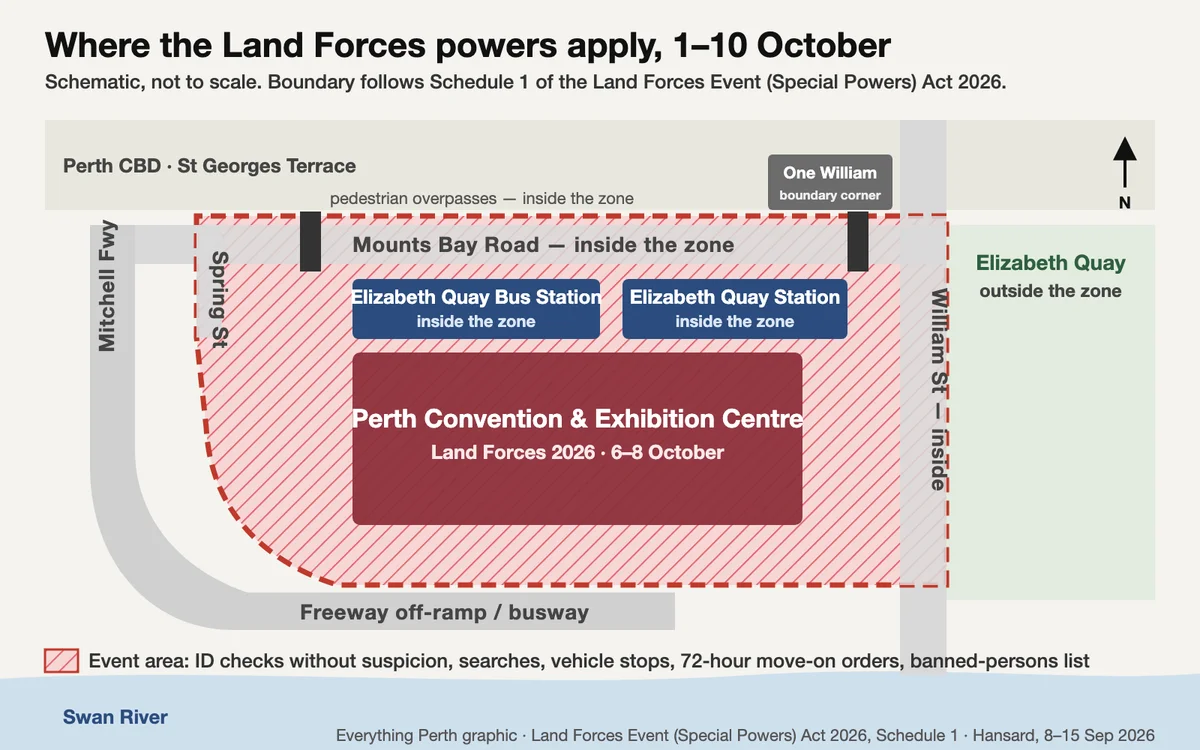
The event area as described in Schedule 1 of the Act. Schematic, not to scale. Both Mounts Bay Road and William Street, footpaths included, are inside the zone. The powers run 1 to 10 October; the expo runs 6 to 8 October. Police may declare further "additional security areas" elsewhere. Everything Perth graphic.
Where. The "event area" is the block bounded by the north side of Mounts Bay Road from William Street west to Spring Street, the Mitchell Freeway off-ramp, the busway, and the east side of William Street. That takes in the convention centre, Elizabeth Quay train station, the Elizabeth Quay bus station, the pedestrian overpasses over Mounts Bay Road and both roads themselves, footpaths included; the ABC has reported that a nearby hotel is also inside. The boundary is anchored on the south-western corner of the One William office tower, so workers on that corner will be crossing in and out of the zone. The minister confirmed that people driving along Mounts Bay Road, or riding a train or bus through the station, are inside the area and subject to the powers; about 15,000 vehicle movements a day use that stretch of road. The Police Commissioner can also declare "additional security areas" anywhere else in the state with a connection to the event, including by urgent order without ministerial sign-off.
When. The powers run from 1 to 10 October, a ten-day window around a three-day show, to cover set-up and pack-down. The Greens tried to narrow it to 5 to 9 October; the Liberals sided with Labor to keep the ten days.
What. Inside the zone, any sworn police officer can:
- Demand your name, date of birth and address, with no reasonable suspicion required. Swinbourn confirmed the Act applies a lower standard than ordinary law: "Under this bill, they do not" need reasonable suspicion. Refusing is not itself an offence, but it makes you an "excludable person": police can then order you out, and breaching that order is.
- Search you (no strip searches) and run you through a metal detector. Refusing a wanding is not an offence either, but it has the same effect.
- Stop and search any vehicle, with no threshold beyond being in the area.
- Seize prohibited items. There are 27 named classes: spray paint, chains and ropes, handcuffs, bike locks and padlocks, "lock-on" devices, adhesives, poles over a metre, marbles and ball bearings, smoke devices, flares, noxious liquids, and "a thing capable of emitting a loud sound, other than a megaphone", among others, plus a 28th that lets the Minister add anything else by regulation, which the Liberals' Nick Goiran called "overkill" and the government conceded was "belts and braces". Signs and banners are not prohibited. You must be given a receipt and be able to collect your property afterwards.
- Give directions, close roads without public notice, and issue move-on orders lasting up to 72 hours, three times the 24-hour limit in ordinary law, and covering areas outside the zone if police choose.
- Require you to remove a face covering where they suspect it is being worn to menace, conceal identity or stir disorder, with a defence for coverings worn in good faith for cultural, religious, medical or mental-health reasons. One Nation's Philip Scott moved to strike the words "cultural, religious" from that defence; the Council voted him down 22 to 2, with Labor and the Liberals both opposing him.
The penalties.
- On the banned list and in the event area: up to three years' jail and a $36,000 fine.
- Failing to comply with a direction or a move-on order, refusing to give your details while being removed from the zone, giving false details, or behaving in a "threatening manner" (which includes offensive language) or using a prohibited item in a way that risks safety or public disorder: up to a year's jail and $12,000.
- Possessing a prohibited item: a $6,000 fine.
- Using a closed road: $1,000.
- For comparison, Goiran established in committee that the ordinary Criminal Code penalty for disorderly conduct is $6,000 with no jail.
If you're stopped in the zone. The Act itself sets some rules in your favour, and they are worth knowing:
- Before requiring your details, a search or the removal of a face covering, the officer must warn you that refusing may get you refused entry, removed, or barred from coming back.
- You can ask the officer to identify themself, and they must.
- Refusing to give your name or refusing a wanding is not an offence. Giving false details is: say nothing rather than lie.
- If anything is taken from you, you must be given a receipt describing it, saying where and when you can collect it, and naming the officer.
- If you turn out to be on the banned list without having been told, the Act gives you a defence if you did not know and could not reasonably have known. You would have to run it in court.
The case for the event and the law
The government's argument is straightforward and it has made it consistently. Defence Industries Minister Paul Papalia, introducing the bill in June: "An event of this scale requires a coordinated security response, which is why these temporary powers are important." Whitby: "These temporary powers will ensure WA Police have the necessary tools to safely manage a major international defence event." The government "recognises the right of people to peacefully gather and protest", it says, but "that right must be balanced with the need to maintain public order". It has set aside a 2,400-square-metre protest area on City of Perth land near the convention centre entrance, with toilets, first aid, fencing and vehicle barriers.
Police Commissioner Col Blanch rejects the civil-liberties case directly. Asked by the ABC about the Human Rights Law Centre's argument that the law would restrict peaceful protest rather than prevent violence, he said: "In fact, it's encouraging protests by making it safe for protesters as well." And: "The best case scenario for us is that it goes smoothly with no one causing harm to anyone at all."
The economic case is the state's defence strategy: Henderson, the submarines, "significant strategic, economic, and industrial benefits for Western Australia and Australia". The terrorism threat level nationally remains "probable", and police told Parliament their assessment of a credible prospect of violence still stands. Police also confirmed the tactical response group is not part of the core plan, though public-order officers will carry rifles, a policy adopted after the Bondi attack.
The banned list
The sharpest power is the excluded-persons list. The Police Commissioner can name anyone he is satisfied "would pose serious threats to the safety of persons or property". On the record in Parliament and in the Act:
- A person can be listed without any criminal record or charge.
- There is no obligation to give reasons and no statutory appeal. The only recourse is judicial review in the Supreme Court, asking a judge to rule the decision was made unlawfully rather than that it was wrong, which in a ten-day event is unlikely to deliver anything in time.
- The government says each listed person will be notified personally, and there will be no public list. The Act requires only "reasonable steps" to contact you, and says expressly that a failure to notify does not affect the list's validity or limit any power.
- The number of people listed will be disclosed only afterwards, in the oversight report.
Blanch told the ABC in August he intends to use it against people involved in the Melbourne protests who might travel west, and people from the east coast "with a history of violence" at protests. On Tuesday Whitby told the Assembly the Commissioner can begin listing people the moment the Act receives assent, and that "certain individuals have been identified", with the number expected to grow. He would not say who or how many.
The precedents are why civil-liberties groups are alarmed. Under the 2011 CHOGM law, 21 people were listed; freedom-of-information requests later showed most had no criminal record. Under the law written for the 2007 APEC summit in Sydney, 61 people with no record were listed, 11 of them Greenpeace members. The one person charged under the CHOGM law was a rigger dismantling a festival stage, arrested hours after being served a notice while buying cigarettes. He was found guilty, fined $500 with $217.50 costs, and penalised a further $1,000 for breaching bail.
The cameras
WA Police began trialling live facial recognition from a marked van in June, an Australian first, scanning faces in public against a watchlist of about 4,000 people with outstanding warrants, thousands of registered sex offenders and reported missing persons. The trial is overt: the van is signed, deployments are published in advance, and police say non-matching faces are pixelated and deleted immediately. Blanch said at the time it was "not about mass surveillance". In Parliament the government said it is "likely" the technology will be used at some point during Land Forces, that photographs of excluded persons would be added to the watchlist "if feasible", that WA Police has one such vehicle and "will not bring in or purchase new facial recognition technology for the purpose of Land Forces", and that it had no data on the system's false-positive rate. Police will also have access to Public Transport Authority, City of Perth, convention centre and Main Roads CCTV, though Whitby said facial recognition would not be applied to those feeds. Automatic number-plate recognition is among the "deployable assets".
Whitby told the Assembly the deployable capability WA Police has acquired for the event, which the government has described as drones, additional firearms, crowd-control equipment, communications and software, will stay with the force afterwards as "a lasting legacy benefit for the state", though "I am not saying it will remain in situ, because after the Land Forces event, our concerns about security in that area will have dissipated".
Who watches the police
Three provisions limit what can be done about any of this while it is happening. Under section 11, the Commissioner's orders declaring additional security areas are "not open to challenge" in any court before or during the event, except for what lawyers call jurisdictional error; Swinbourn did not dress that up: "these kinds of provisions are extraordinary and unusual. We do not resile from that fact." Under section 54, police, and the State itself, are immune from being sued for anything done in good faith, so there is no one left to sue; McNeill quoted the man who is now Attorney General, Tony Buti, speaking against the identical CHOGM clause in 2011: "It is always a concern when people are not held responsible for their actions." And under section 51, if you are charged with carrying a prohibited item, it is for you to prove your excuse, not for the prosecution to disprove it.
The Council's biggest win is oversight. The Corruption and Crime Commission must scrutinise the exercise of the special powers, can enter police premises and compel officers to answer, and must report within four months, with the report tabled in Parliament by 10 April 2027. Goiran, who had wanted the Ombudsman, welcomed the switch: "The Corruption and Crime Commission is the specialist body for the oversight of WA police." Two gaps survived. Police are not required to keep records of wandings or of who they put on the banned list, an omission Goiran spotted on the floor and the minister conceded he had missed; and the Minister must cut from the published report anything the Commissioner advises would prejudice an investigation or reveal operational methods. The police powers switch off on 11 October; the immunities and the CCC's oversight division stay on the books until proclamation, so the Commission can finish its work.
The Council also won two smaller protections. Commuters passing through the zone on a train or in a car without getting off cannot be prosecuted. And police cannot refuse entry to the area except on safety grounds, or to someone on the list, or to someone who has just refused an ID check, a search or a wanding; Whitby confirmed an officer is under no statutory obligation to tell you which ground applies.
The people already living there
Not won: anything for the people who sleep rough on that stretch of the foreshore. They "will not be permitted to continue to be in the area", Swinbourn said. Asked by the Greens' Brad Pettitt whether they would be housed, he replied: "I cannot promise that I can provide accommodation for them." Pettitt: "These people literally have nowhere to go." Swinbourn, who is also Homelessness Minister, promised outreach.
Is it unconstitutional?
The Human Rights Law Centre wrote to Buti on 20 August warning that the bill, together with the government's separate Public Order Legislation Amendment Bill, is "vulnerable to constitutional challenge for impermissibly burdening the implied freedom of political communication", and asked Parliament to withdraw both. The High Court has held that the Constitution contains an unwritten guarantee that Australians can communicate about political matters; it is not a personal right to protest, but a limit on what parliaments can do. The Centre's legal director, Sarah Schwartz, called the bills "an attack on the right to protest" and "significant overreach into fundamental democratic freedoms". She told the ABC: "We are really concerned that a heavy police presence [and] granting police extraordinary powers to harass and restrict peaceful protest actually does the opposite of keeping protesters safe."
The argument has teeth because of what happened in Sydney five months ago. In Jarrett v State of New South Wales, decided on 16 April, the NSW Court of Appeal, led by Chief Justice Andrew Bell, struck down in full the Minns government's post-Bondi laws allowing police to restrict public assemblies, finding they impermissibly burdened the implied freedom. The plaintiffs were a Blak Caucus organiser, a Palestine Action Group organiser and a member of Jews Against the Occupation '48. The state was ordered to pay their costs.
The WA government says its bill was drafted before Jarrett came down, that it has considered the judgment since, and that it is "comfortable and confident about the constitutionality of the bill". It has advice from the State Solicitor's Office, which it will not release or even date. It notes that Jarrett is NSW law, that the CHOGM Act was never challenged, and that the Council added limits to the security-area sections specifically to guard against a challenge.
The counter-argument, put by McNeill, is that a protest moved or prevented on the day "cannot be restored by a court decision weeks or months later". She said in the Council that groups were interested in mounting a constitutional challenge. No vote on the bill itself was ever forced in either house; it passed on the voices. The Greens opposed it at every stage, and on the only substantive division, over the boundary of the zone, they were joined by Animal Justice's Amanda Dorn. Labor, the Liberals, the Nationals and One Nation all voted to keep the clause as drafted, 26 to 5. Goiran's position for the opposition was that "this is a special case, but it is not unprecedented".
What happens on 6 October
The WA Anti-War Collective has called its protest for 5pm on Tuesday 6 October at Yagan Square, on the corner of Wellington and William streets, according to its listing on the Green Left events calendar, under the banner "No warmongers in Boorloo". The march route is listed as pending a permit. Yagan Square is outside the event area; William Street runs straight down into it, and the zone's north-eastern corner is where William Street meets Mounts Bay Road, about a kilometre south.
The collective grew out of the anti-AUKUS movement. In May, 14 groups rallied more than 100 people outside the same convention centre against the Indian Ocean Defence and Security expo; Green Left, which covered it, reported Sam Wainwright, a founding member of both Stop AUKUS WA and the collective, telling the crowd: "The push by the state and federal governments to make Australia a major weapons exporter is making the world a more dangerous place." McNeill called it "deeply shameful that WA Labor is cosying up to the US military".
The collective has told Parliament, in a statement tabled by McNeill, that it will not use the designated protest area, which it called "a theatrical attempt to claim that protest rights have been preserved", and that its event "on 8 October will begin and terminate outside the 'Event area'". One permit has already been refused: a group applied to protest in the convention centre's Summer Garden, inside what will become the zone, and, McNeill told the Council, was knocked back; Swinbourn said negotiations were continuing. He also made a point worth remembering: "permits are not permission to protest. They are more of a notice or device to give protection to protesters."
The minister could not say whether someone standing peacefully with a banner near the bus station or train station would be moved on; the answer, he said, turns on private property and land-management rights, and he understood the property holder would not consent. He confirmed that carrying an item for the purpose of peaceful protest does not count as a "special justification" for having it. And he would not rule out declaring the area around a planned Elizabeth Quay protest, outside the zone, an "additional security area", saying no decision had been made and it would depend on circumstances.
One benchmark to hold October against. Under the CHOGM law, with a far bigger footprint covering Burswood, Government House, hotels and motorcade routes, police searched 70 people, seized no prohibited items, listed 21 people and laid one charge. The powers switch off on 11 October. The CCC's report, due by 10 April 2027, will tell us how Perth compared.
Sources: Land Forces Event (Special Powers) Bill 2026 and Hansard, Legislative Assembly and Legislative Council, 8 to 15 September 2026; Votes and Proceedings No 81 and Council Minutes Nos 79 and 80; WA government media statements of 18 June and 16 September 2026; AMDA's Land Forces 2026 exhibitor directory, checked 16 September 2026; ABC News, 20 August and 19 June 2026, 14 April 2026, 14 August 2025, and 11 and 12 September 2024; Victoria Police public notice, special police powers 6 to 15 September 2024; Human Rights Law Centre, 20 August 2026; Jarrett v State of New South Wales [2026] NSWCA 62; UN Independent International Commission of Inquiry on the Occupied Palestinian Territory, 16 September 2025, and OHCHR appointment notices, November 2025 and January 2026; International Court of Justice order of 26 January 2024; Amnesty International, December 2024; Human Rights Watch, December 2024; B'Tselem and Physicians for Human Rights Israel, July 2025; International Association of Genocide Scholars, August 2025; Gaza Ministry of Health, 15 September 2026; The Lancet Global Health, Gaza Mortality Survey and subsequent correspondence; Green Left, June 2026 and its events calendar; Euronews, 2 June 2026.
Comments