
Only one in five girls in a Western Australian secondary school says she feels safe all of the time. For boys in the same year groups, the figure is closer to one in three.
That gap is one of the starkest findings in the Speaking Out Survey 2025, the summary report of which has now been published by WA's Commissioner for Children and Young People. It is the only statewide survey in Australia that tracks children's wellbeing over time, and this was its third run after 2019 and 2021.
The scale is unusual for a piece of government research. Commissioner Dr Jacqueline McGowan-Jones and her staff drove roughly 35,000 kilometres, spent 142 days on the road across Terms 2 and 3 of 2025, and visited 122 schools in 92 suburbs and towns. About half those schools were in metropolitan Perth. In all, 16,169 students from Years 4 to 12 consented to take part — a record for the survey.
What the girls said
The headline pattern in the data is not that WA children are unhappy. Most reported good physical and mental health, said their basic needs were met, and named a supportive adult in their life. But the closer you look at who is reporting the worse outcomes, the more consistently the answer is: older students, and girls.
On life satisfaction, 65.5 per cent of secondary school boys rated themselves between 7 and 10 out of 10. For girls it was 45.8 per cent. At the bottom of the scale, 22.3 per cent of girls scored themselves between 0 and 4, against 11.9 per cent of boys.
Girls were more likely to miss main meals, less likely to say they had a supportive adult who would actually listen, and less likely to be allowed to travel independently or make decisions about their own lives. A quarter of all young people surveyed (25.4 per cent) had spent a night away from home because of a family problem; among girls it was 30.4 per cent.
Boys were more likely to report being physically harmed by someone on purpose — 46.6 per cent against 36.0 per cent. But of the young people who had been harmed, girls were far more likely to say it happened at home, and twice as likely to say the person who hurt them was an adult.
Mental health, and the wall in front of it
Nearly two in three young people (61.7 per cent) said they had felt sad, anxious or depressed for more than two weeks in a row. More than one in three (35.7 per cent) reported mental health concerns outright.
One in four (25.2 per cent) said they had needed to see someone about their health and had not been able to. When students explained why, cost and availability came up — but so did something harder to fund away. Feeling like a burden was one of the most frequently given reasons, along with being too afraid to raise it with a parent.
School
Liking school falls off a cliff between primary and secondary. Some 84.2 per cent of primary students agreed they were happy at school; among secondary students it was 64.8 per cent. Nine in 10 young people said they felt pressured by schoolwork, describing both the sheer volume and the fear of disappointing parents and teachers.
Bullying mostly happens at school — 91.5 per cent of young people who were bullied said it happened there — and 16.9 per cent of young people had missed school because of it. One in four had been bullied over their cultural background, skin colour or religion. For Aboriginal children that figure was 44.6 per cent, against 23.3 per cent for non-Aboriginal children, and it rose to 48.8 per cent for culturally and linguistically diverse students.
Of the young people who had been suspended, more than half (55.8 per cent) were suspended for 10 days or more.
What the Commissioner is asking for
For the first time, the survey carries formal recommendations. There are five, and they are deliberately structural rather than program-sized: write the United Nations Convention on the Rights of the Child into WA law; write the National Child Safe Principles into WA law; build a single whole-of-government Child and Family Wellbeing Strategy; review whether existing programs actually align with the Equal Opportunity Act, the School Education Act and the Children and Community Services Act; and run a genuine public prevention health campaign aimed at children themselves.
"Despite WA's strong economy and overall prosperity, a significant number of young people continue to report barriers to accessing critical services such as education, health and mental health." — Dr Jacqueline McGowan-Jones, Commissioner for Children and Young People
The Commissioner notes there is no shortage of WA strategies already — on homelessness, family violence, child protection, racism, bullying, youth crime — but no single approach that treats a child's life as one thing.
Why it matters here
More than 656,000 children and young people under 18 live in WA, and most of them live in Perth. This survey is the closest thing the state has to asking all of them directly how it's going, and it now has three data points across six years telling the same story: outcomes slide as kids get older, and they slide further for girls.
Dr McGowan-Jones's term as Commissioner ends this year. A fuller report on the 2025 data is due later in 2026. Whether the five recommendations go anywhere is a matter for the next Commissioner, and for a government that has just been handed 16,169 students' homework on itself.
The findings were reported by The West Australian on Wednesday 16 September 2026.
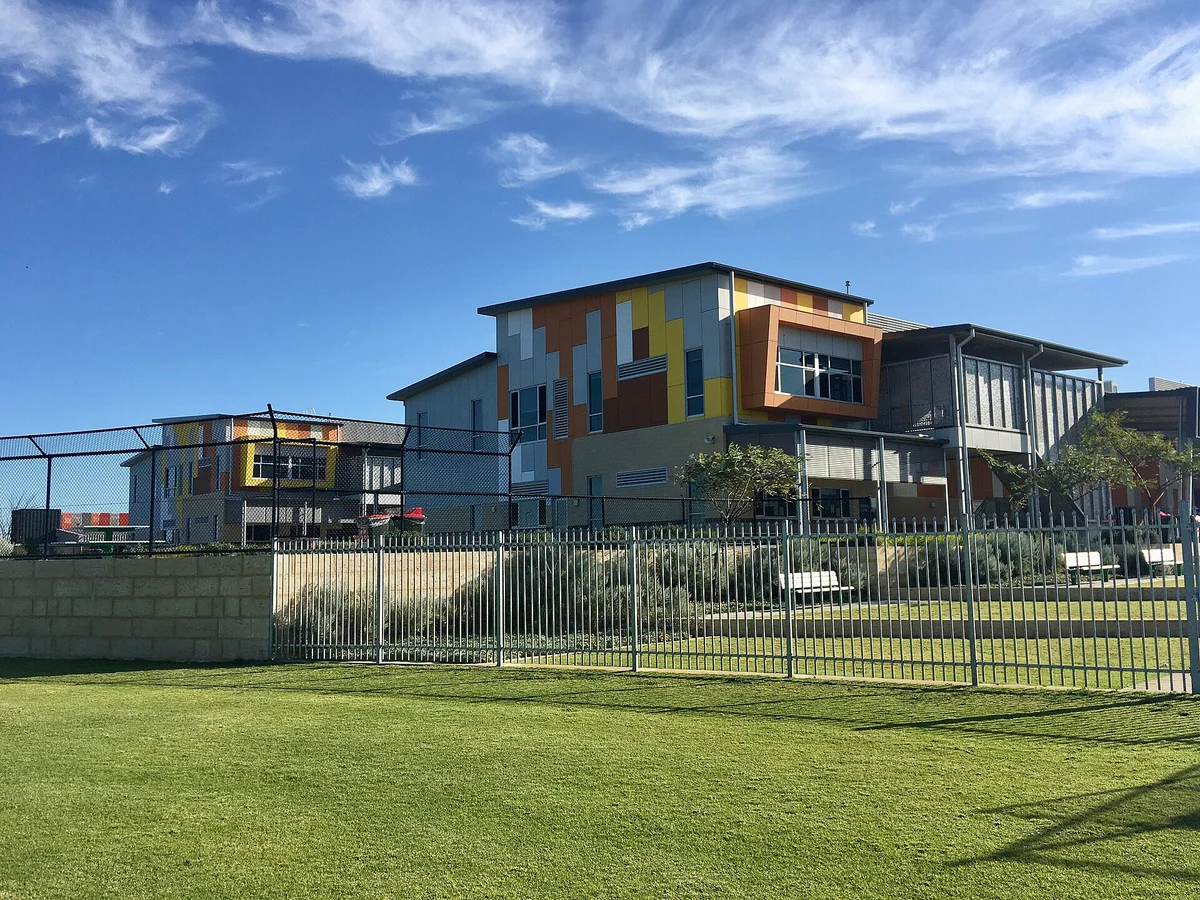
Photo: Steelkamp via Wikimedia Commons (CC BY-SA 4.0). Harrisdale Senior High School is pictured as a file photo of a Perth public secondary school; it is not connected to any specific finding in the survey.
Comments