A Perth children's doctor whose research found skin infections in almost half the children in remote Aboriginal communities, and then showed how to bring that number down, has been named Australia's Life Scientist of the Year.
Professor Asha Bowen received the 2026 Frank Fenner Prize for Life Scientist of the Year at Parliament House in Canberra on Tuesday 24 November, when Prime Minister Anthony Albanese and Science Minister Tim Ayres announced this year's Prime Minister's Prizes for Science.
Professor Bowen is a paediatric infectious disease specialist at Perth Children's Hospital and The Kids Research Institute Australia, The West Australian reported.
The federal Department of Industry, Science and Resources said she was recognised for research and partnerships with Aboriginal communities that transformed the prevention and treatment of skin infections in Aboriginal children, and for work that has reshaped national guidelines.
"It reflects teamwork, hard work and persistence." — Professor Asha Bowen, speaking to The West Australian
What the research found
According to The West Australian, Professor Bowen's work showed that at any given time almost one in two children living in remote Aboriginal communities had impetigo, or skin sores, caused by Strep A bacteria. The newspaper described that as the highest documented prevalence in the world.
She later found about one in five Aboriginal children living in urban centres also had the infections, and that between a third and a half of remote children with a skin sore also had scabies.
Strep A infections matter well beyond the skin. Left untreated they can lead to rheumatic fever, rheumatic heart disease, kidney disease and sepsis. The West reported that about 90 per cent of Australia's rheumatic fever cases occur in Aboriginal communities.
Professor Bowen told the newspaper she found those infection rates "unacceptable" in a country with the means and the health system to deal with them.
The Kimberley trial
The centrepiece of her work is the See, Treat, Prevent trial, known as SToP, which ran across nine remote communities in the Kimberley.
The West reported the trial showed a short course of oral antibiotics worked just as well as painful penicillin injections for treating skin sores, and that it cut the rate of skin sores in children by 50 per cent. The paper described the result as the first significant reduction in skin infections among Aboriginal children in 50 years.
A second study, called the Missing Piece, found Aboriginal children in remote communities also had a high rate of low-grade Strep A throat infections that were going undetected.
Professor Bowen told The West that regular skin checks, and a focus on skin health generally, were probably what started to drive infection rates down.
The other winners
This year there were two recipients of the top award, the Prime Minister's Prize for Science: melanoma researcher Professor Georgina Long and subatomic physicist Professor Anthony Thomas.
Professor Mark Smythe won the Prime Minister's Prize for Innovation, Professor Christopher Matthews won the prize for Aboriginal and Torres Strait Islander Knowledge Systems, and Associate Professor Fengwang Li was named Physical Scientist of the Year.
There was a second WA name on the department's list. The Bundiyarra–Irra Wangga Language Centre, which the department said has spent nearly two decades preserving Aboriginal languages across the Midwest, Murchison and Gascoyne, was highly commended in the knowledge systems category.
What happens next
The work is continuing. The West reported that Professor Bowen's team is now trialling a 15-minute on-the-spot test for Strep A throat infections, so children can be treated sooner.
In WA, Aboriginal community-controlled health organisations and country health services are putting her team's healthy skin tools to use, according to the newspaper, and those tools are being expanded to include sun-safety messages. The team has also built an online hub with storybooks, treatment guidelines and an app for families and health workers.
For Perth, it is a national prize for research that was led from the city's children's hospital and carried out in partnership with communities in the State's far north.
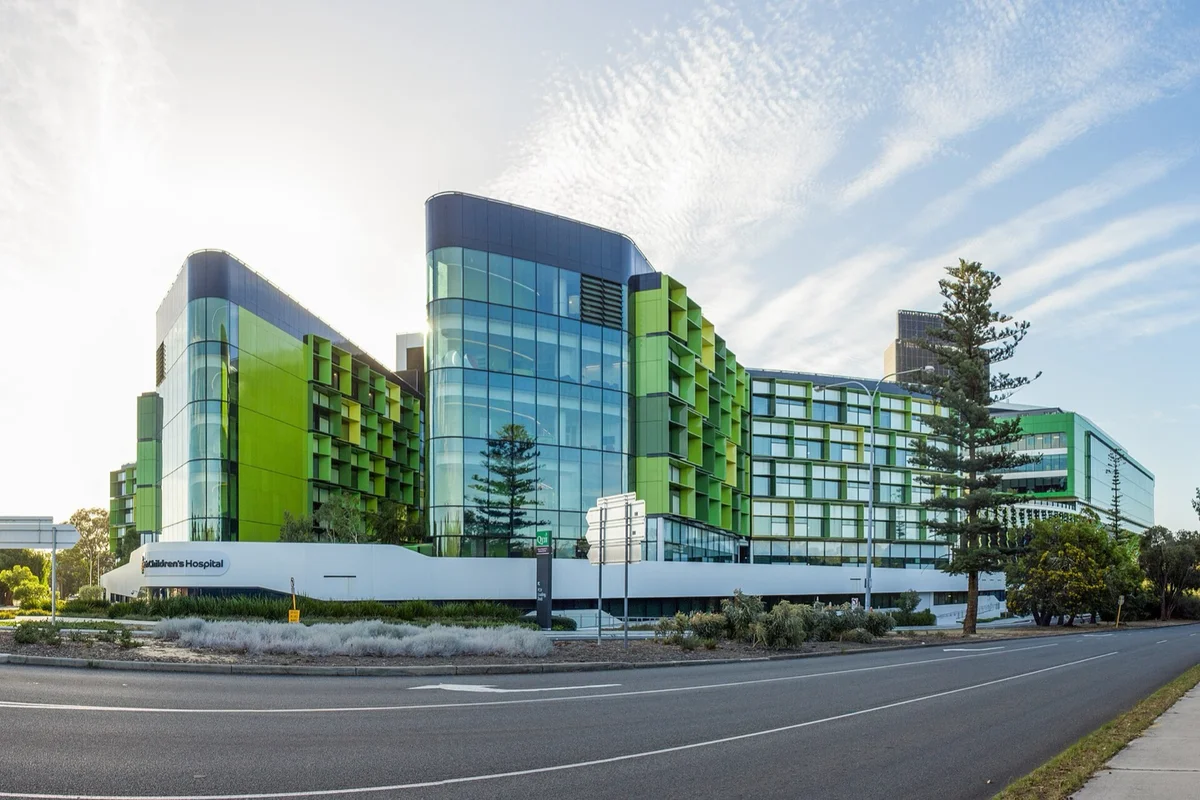
Photo: Perth Children's Hospital in Nedlands (file photo). Samuel Wiki via Wikimedia Commons (CC0).





Comments