
Across five sitting days, both houses of the WA Parliament have argued about one government-owned house in South Hedland. The opposition says as many as 15 children have been living there without adults. The Minister for Child Protection says that is not what she found. Between those two positions sits a departmental office running at 27.84 of its 38 funded positions, an investigation the minister admits "has taken too long", and a government that refused almost every specific question put to it.
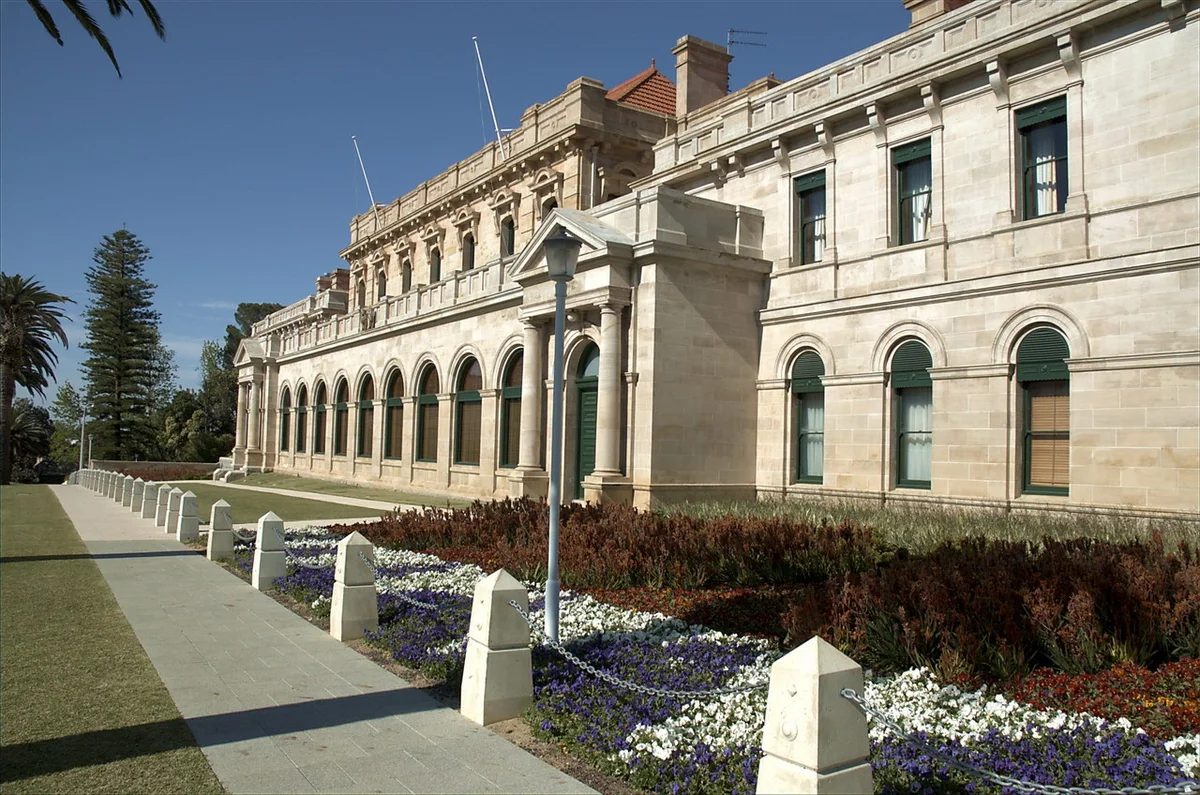
Parliament House, Perth. Across five sitting days in September, questions in both chambers about one government-owned house in South Hedland produced almost no answers. Photo: Nachoman-au, CC BY-SA 3.0, resized.

This is what is on the parliamentary record, where each claim comes from, and what has actually changed. Hansard quoted here is the uncorrected daily proof — the same-day draft, published before it has been reviewed.
What started it
On Saturday 12 September, The Weekend Australian published an investigation by Ros Thomas headlined "Forgotten children of South Hedland left to fend for themselves in 'hellhole' house". It described a Homeswest property in Frisby Court, South Hedland, and children living there without adult supervision.
Almost everything Parliament has been told about the house traces back to that single article. The exceptions are thin. Liberal deputy leader Libby Mettam told the Assembly on 16 September that "a caseworker confirmed" children were living there unsupervised, without naming the caseworker or producing anything. Hon Julie Freeman, a Nationals member of the Legislative Council, told that chamber she had once driven up the street by accident — an account of the street, not of the house.
The fullest version of the allegations entered the record at 9:07 pm on Tuesday 15 September, when Freeman read a long extract of the article into Hansard, saying she wanted "to make sure that what triggered that flurry of questions is on the record in this place". A members' statement is one of the few chances a member gets to put something on the record at length, and it is protected by parliamentary privilege.
The article, as read into Hansard, describes "a putrid bedroom littered with dog excreta is heaped with soiled clothes used as makeshift bedding", "the reek of unwashed bodies, layers of filth and urine-soaked floors", and a cul-de-sac of 21 brick houses "sheeted with smashed glass, beer bottles and cans" where neighbours "barricade themselves behind head-high fences with chains and padlocks".
Two people from the street are named in it. Pat Mason, 67, described in the article as a Kariyarra elder who worked in Aboriginal affairs in the WA judicial system for four years and in Aboriginal health for 35, is reported as saying her people are appalled that the children have been left to fend for themselves. In a passage she prefaced "this is a dangerous thing for me to say", she spoke about the sexual abuse of Aboriginal girls by Aboriginal men, and is quoted directly: "DCP haven't got their priorities right: stop removing the children from homes where there's sexual abuse and start removing the perpetrators instead." Also: "Nobody's watching the kids in this town."
Ian Beagle, 68, a neighbour, is quoted saying he had made three appeals to the department this year and that "there's been no response from child services". The article quotes him saying: "I want these kids moved into a safe house before another Alice Springs happens here."
Freeman's own words, after she finished reading, were the least partisan of the week: "What has been reported in South Hedland is a stain on our society and it is a damning failure of government — past governments, present governments, all of us." She went on: "We must never forget the terrible legacy of the stolen generations … Acknowledging the mistakes of the past cannot mean turning a blind eye to neglect today." And: "We cannot allow our fear of being labelled a racist or sensitivity around intervention to override our most basic responsibility of government — keeping children safe."
Everything Perth has not independently verified any of it. What follows separates what the article said, what members asserted, and what the government confirmed.
The number everyone is arguing about
The figure driving the fight is 15 children. It is worth being precise about where it comes from, because it has been repeated in Parliament as though it were established.
It appears once, in the article, in this sentence: the department has known "for at least nine months, if not years" that "as many as fifteen children — the youngest aged five and seven — have been living here alone, fending for themselves without parents or adult supervision for up to a week at a time."
Three things follow from the text itself. The number is asserted in the newspaper's own voice, hedged as "as many as", and no source is named for it. The quoted phrase about departmental knowledge — "for at least nine months, if not years" — is attributed to someone the article does not identify. And the figure does not sit easily with the rest of the piece, which opens by describing four children present, refers later to "the parents of three of the children", and quotes the neighbour on "four older girls living in there too".
No member of the Legislative Council put the figure of 15 to the government in a question. Hon Nick Goiran, the Liberal leader in the Council, asked about "several children, including a child as young as five years old". In the Assembly the opposition used it freely: Mettam told the house "as many as 15 children have reportedly been living in absolute squalor in housing managed by this government".
The minister's denial
On the afternoon of Tuesday 15 September, replying to an opposition motion, Minister for Child Protection Jessica Stojkovski (Kingsley, Labor) directly disputed the central claim. It is the most substantive thing any minister has said about the house:
"While there are concerns at Frisby Court more widely, I need to refute the claims in the media, and repeated here by the opposition, that up to 15 children are regularly unsupervised. I did not say that it was not that bad. I did not say that it was not as bad as 15 children. They are not living unsupervised in the house for days at a time. I did not find evidence of that when I visited."
Her stated basis was "not only … my own interactions, but also … conversations with staff from the many departments I met with and community sector partners".
She confirmed she had been to the street: "I visited Frisby Court not once, but twice." She met the Department of Communities, the Department of Housing and Works, the Department of Education, WA Police, MacKillop Family Services, Julyardi Aboriginal Corporation and community representatives.
She would not supply an alternative number. Opposition Leader Basil Zempilas (Churchlands, Liberal) pressed: "So how many is it, then? How many children are living unsupervised in Frisby Court? If it is not as bad as has been reported, in what shape or form is the situation different from what has been reported?" No figure was given, then or since.
The next day Mettam asked her directly whether, during what she called "six daylight hours in the Pilbara", the minister had gone and inspected the house. The minister's entire answer was:
"The residence in question is a private residence. Despite the tenure, whether social housing or not, it is a private residence and I do not have the statutory authority to enter a private residence without invitation."
She did not say whether she went onto the property, whether she spoke to anyone there, or whether she saw the children. Asked on the supplementary to "confirm that those children were safe and supervised by adults last night", she said: "As I said yesterday, it still stands, this family is getting all of the supports that they need."
On the brevity of the trip — Mettam said she arrived at 4:30 pm and left at 11 am the next morning, holding a press conference of "just over a minute" — Stojkovski said: "Yes, it was a short visit, because we had Parliament last week and Parliament this week."
What the minister conceded
One concession has been made repeatedly and is not in dispute. On 15 September: "In this case, the child safety investigation has taken too long. The department is working urgently to conclude this investigation."
On 16 September, pressed by Nationals member for Geraldton Kirrilee Warr on whether staff vacancies had contributed to that delay, she repeated it — "this particular investigation has taken too long" — and, after a burst of interjections, added: "That is why I took decisive action to appoint the chief practitioner to oversee all child safety investigations in Hedland and South Hedland and the child intensive support services."
She did not concede the causal link to staffing, and did not answer Warr's second question — why additional staff were being sent only now. What she said instead was that "staffing in regional WA is a challenge. We are one of the biggest jurisdictions in the world", and pointed to an increase in the number of child safety practitioners of 40 per cent, a finalised child protection bargaining agreement, a reclassification of roles she says she ordered early in her tenure, and a statewide relieving team deployed to districts with vacancies or staff on leave. She gave no baseline year and no absolute numbers for the 40 per cent.
The staffing numbers
The hardest information of the week came in the Legislative Council on 15 September, in answers to Freeman and Liberal MLC Hon Michelle Boylan. These are the only real numbers the government has put on the table.
The South Hedland child protection office:
- Total funded establishment: 38.00 full-time-equivalent positions. Current staffing: 27.84 FTE — a shortfall of 10.16, a little over a quarter of the office.
- Frontline child protection practitioner positions: 14.40 FTE established, 9.60 filled, 4.80 vacant.
- Days those vacancies have been unfilled: 138, 101, 71, 42 and 38. The longest has been open since roughly the end of April.
- Average length of service of practitioners at the office: 4.06 years.
Two caveats the answer does not address. No as-at date was given for any South Hedland figure. And five vacancy durations are listed against 4.80 FTE of vacancy — so either the vacant roles are part-time fractions, or the list and the FTE count are measuring different things. The government has not explained which.
A related misreading has gone uncorrected. In the Assembly the next day, Warr put it to the minister that the Council answers "revealed more than 10 FTE positions are vacant". The Council answer says the office is 10.16 FTE below its establishment, and that 4.80 FTE of practitioner positions are vacant. Those are different things. The minister neither confirmed nor corrected the figure.
The Pilbara region: 11 vacant FTE positions as at 31 August; the statewide relieving team deployed to the region 10 times in 12 months, about 11 weeks in total. Boylan asked for the caseworker-to-child ratio; the answer supplied a different statistic — an average caseload of 10.77 as at 4 September — without flagging the substitution.
Reinforcements, dated: "Two senior development practitioners arrived in Port Hedland today and a senior child safety practitioner and child safety practitioner will arrive tomorrow" — two on 15 September and two on 16 September, four in all, arriving as the house sat.
The questions, and the answers that never came
Between 8 and 16 September members of both houses put detailed, answerable questions to the government about the property. The pattern of response is the story.
Goiran asked when the department first received a report about a child at the address this year, how many it had received, how many investigations were commenced, and whether police were involved. The complete answer: "The Department of Communities does not disclose information about individuals, due to privacy and confidentiality obligations under the Children and Community Services Act 2004." The aggregate counts — which on their face identify nobody — were refused along with everything else.
Australian Christians MLC Hon Maryka Groenewald asked three dates: when the department was first notified, when a child protection officer first attended, when one most recently attended. Same refusal, with an addition: "The Department of Communities has acted in accordance with its legislative obligations and has consistently responded to concerns … the department has undertaken required investigations and actions, including providing social services through local agencies." No dates, no counts.
Liberal MLC Hon Neil Thomson asked the Housing Minister whether the primary tenant is an adult, whether the department knows the tenant's whereabouts, when rent was last paid, and whether child protection advice was sought. Hon Jackie Jarvis refused, citing "privacy and confidentiality obligations" — naming no statute at all. She had given a near-identical answer to a different question minutes earlier. Thomson interjected: "That's the same answer you gave last time. Maybe you shouldn't even bother answering it." The Deputy President called the house to order; Jarvis said "I will start again because I have lost my place," and read it again.
Thomson had also asked whether the property is currently fit for occupation — a question about a building, not a person. It was refused on privacy grounds too.
Freeman asked when the minister was first briefed, whether the children are now safe and no longer unsupervised, how many other South Hedland cases in three years were not acted on within seven days, and what the minister has done since. The answer, incorporated into Hansard later that afternoon, answered none of the four.
In answer to the specific questions put in both chambers, the government confirmed or denied nothing property-specific: not a date, not a count of notifications, not the number of investigations, not whether police were involved, not whether the house is fit to live in, not the neighbour's three reported appeals, not the claim that the department had known for nine months or more. The one element any minister engaged with was the number of children — and there she denied the reported figure without offering another.
Housing and Works Minister John Carey also declined case detail, describing instead a regional tenancy support program of "weekly visits", referrals to not-for-profit services and, in some cases, "direct intervention by the agency to get a skip bin onto a property to help clean it up". He said there had been "ongoing and regular support" by his department. He did not say what concerns were raised with it, or when. He was required by the Speaker to withdraw the word "disgrace" applied to Warr, the member for Geraldton; the following day the government used one of its own questions to attack her again, on the day she pressed the minister on South Hedland staffing.
The Premier, Roger Cook, would not engage with the case itself. Asked by Nationals leader Shane Love what evidence satisfied him the children were safe, he attacked the premise: Love had prefaced the question with the assertion that Cook had "defended this decision not to remove the children". Cook called that allegation "reprehensible and disgusting" and went on: "I defended the work of our child protection workers … I made no comment at all in relation to this specific case. I do not have the facts in front of me — neither do members opposite." He disclosed no evidence, and said the government "continue[s] to resource the department as necessary".
The vote
On Tuesday 15 September Mettam moved a matter of public interest — a short, set-piece debate on a single topic, held on the day's notice. Her motion: "That this house condemns the Cook government's systemic failures of child protection across Western Australia and draws the house's attention to the tragic conditions currently facing children in South Hedland and Kununurra."
Only four members spoke — Mettam, Love, Zempilas and the minister. No government backbencher contributed.
It was defeated 14 votes to 36, the Assembly's only division that day. The 14 ayes were opposition and crossbench members, among them Luke Herdegen, sworn in as the member for Secret Harbour earlier that afternoon following the by-election. All 36 noes were Labor. Unusually, the Acting Speaker, Scott Leary, both presided and voted, and voted with the ayes.
The resignation demand
The following afternoon, Wednesday 16 September, Zempilas put four alleged failures to the minister and demanded she go:
- "Her failure to read a critical Children's Court judgement" — asserted as fact.
- "Her failure to apologise for departmental inaction involved in the deaths of three young children" — asserted as fact.
- "More than 50 police attendances at Frisby Court despite repeated warnings that children were at imminent risk" — asserted as fact, unattributed.
- "Allegations that 23 notifications of sexual abuse involving one child in Kununurra failed to trigger a child safety investigation" — the only one framed as an allegation.
None of the first three has been confirmed or denied by the government, by police or by the department, and no document has been produced for any of them.
Then: "How many warnings involving vulnerable children have to be ignored under the minister's watch before she accepts ministerial responsibility and resigns?"
The question was so disrupted by interjections that the Speaker made him start again from the beginning.
The minister's answer did not use the word "resign". She began by saying that "while some of the things that the Leader of the Opposition brought up in his question have crossover into my portfolios, they are actually matters for police" — her explanation for not addressing them — and then spoke only to the Kununurra matter: "All reports of child sexual assault — in fact, all sexual assaults — are taken very seriously. Child protection safety practitioners are mandatory reporters … They are not an investigative body for sexual assault; that is done by police." She added that she understood the mandatory reporters "did report to police and police are looking into the matter".
On the supplementary, she turned it back on the opposition: "If the Leader of the Opposition has actual, factual details that a child is being harmed in their home, he needs to make a referral to the child protection district responsible, and a child safety investigation will occur."
Everything Perth is not publishing further detail about the Kununurra allegation while a police investigation is on foot.
The Hawke children
Running underneath the South Hedland story is an older one. Jamelia Hawke, Arnda Hawke and Kelvin Hawke died in 2022. Their grandmother, Yamatji-Wajarri woman Dorothy Papertalk, gave an account to The Australian Weekend Magazine about three weeks before the South Hedland article.
The circumstances of the deaths are not on the government's record. The ages — 10, seven and four months — the manner of death and the description of their mother appear only inside the newspaper extract Freeman read into Hansard. Mettam has repeatedly told the Assembly, under parliamentary privilege, that the children were murdered by their mother. The government has never described how they died.
What the minister has said, on 9 September: "The Department of Communities accepts that there were failings in its involvement with this family." She also told the house that "the coroner subsequently determined not to hold an inquest into those deaths based on all the information he had at hand". Mettam's competing account, six days later, was that "a critical email — new evidence — was produced as a trigger for an inquest, and an investigation was ordered". The two statements sit in direct tension and neither has been reconciled on the record.
Mettam's further account in the house, attributed to reporting: Papertalk made five appeals about her grandchildren's safety; police raised the alarm 11 days before the deaths after Jamelia was struck in the face with a rock; the department determined a child safety investigation was warranted eight days before the children died, but it "never commenced because a critical email sat unopened in the inbox of a staff member who was on leave". The government has not confirmed or disputed those details.
What the government has confirmed, in the Council on 15 September:
- A further review was ordered on 27 August 2026, to check whether the findings of the department's internal practice review and the Ombudsman's statutory child death review were actually implemented.
- It is being done by the Nous Group and Kate Alexander, chief executive of Barnardos Australia and a former chief practitioner for child protection in New South Wales.
- It is due on 31 October 2026.
- The minister was briefed on the matter in July 2025.
- Earlier reviews "identified systemic issues rather than failures attributable to individual staff members".
Asked directly whether any disciplinary or performance action followed the failure to commence that investigation, the government gave no yes or no. Three separate requests to produce documents were turned down on three different grounds: the internal review and the department's response to the Ombudsman were refused for want of time, with the member invited to put the question on notice; the document commissioning the new review was deferred until the review is finished; and an unrelated evaluation report was withheld on grounds of "privacy, confidentiality and the report's currency".
The apology became its own dispute, and the record shows the minister putting it two ways within about ninety minutes. Answering a question that afternoon, she said: "in my last response I did say that I pass on my condolences to Dorothy. It was the first thing that I said to her after she sat down in our meeting." In the debate that followed, it became: "I apologised to her. It was the first thing that came out of my mouth." Mettam's point was precisely that distinction: "We appreciate that there were condolences, 'Sorry for your loss' but is the Minister for Child Protection sorry about the failures…?" Papertalk was among the community representatives the minister met in Hedland.
The Council's motion of grave concern, and the judgment the minister admits she read only in part
A week earlier, on 9 September, the Legislative Council spent two hours on a motion by Goiran expressing "grave concern at the unsatisfactory performance of the Minister for Child Protection". It concerned a different case entirely: JAH and ADH v The Chief Executive Officer of the Department of Communities [2026] WACC 2, decided by Magistrate Horrigan on 5 June 2026.
The case was brought by foster carers seeking a special guardianship order over a boy, known in the proceedings as KJA, until he turned 18. He is of South Sudanese heritage, was placed with them at four months old, and was seven when the case was decided. The court declined the carers' application — which is why the minister was able to describe the outcome as going the department's way — and found that placement with his South Sudanese maternal grandmother was consistent with his best interests, noting he had been spending alternate weekends with her and was happy and well cared for.
But the magistrate also made findings about the department. Its cultural plans for the boy were "inadequate and largely meaningless rhetoric", containing "motherhood statements and hopes" with "no active plan"; a cultural support plan filed in the proceedings "only scraped the surface" of his culture "in a superficial manner"; and delay had worked against his best interests.
The motion's sharpest paragraph was about who knew what, and when. The director general did not learn of the judgment until it was raised at a budget estimates hearing 19 days after it was delivered; he was not fully briefed for 24 days; and the minister was not briefed for 42 days. It also criticised her for saying the court had ruled in the department's favour while having read only "parts" of the judgment — her own characterisation, and the basis on which the opposition's stronger claim, that she had not read it at all, rests.
The motion passed on the voices — agreed without a formal count — after an amendment struck out three of its four document orders. The government opposed it but tabled papers mid-debate, conceding that cultural planning "between 2019 and 2022 required improvement", that the department "agreed with the magistrate's recommendations around the transition plans", and admitting that no policy exists for escalating adverse Children's Court judgments to the director general or the minister. It cited section 237 of the Children and Community Services Act 2004 for withholding material, and offered private briefings instead.
One further thing was said in that debate that bears on this whole story. Greens MLC Hon Jess Beckerling, who said she had read the judgment twice, attacked the newspaper report the motion partly relied on: she did not find the article "constructive or sensitive", said it ignored the court's finding that the grandmother was ready to care for the boy, and said "the author did not understand that a person does not need to read and write in English to be a good parent".
Why the government says it cannot answer
The refusals have been near-total, and the minister has given a reason for them that deserves to be heard in full. Speaking in the 15 September debate about the boy in the Children's Court case, she said:
"I am not going to apologise for keeping the details of this child out of the public domain, regardless of the fact that I have parliamentary privilege in this place. I am aware that others in the other place have come very close to the line on revealing the identity of this child. In fact, many in this child's community know exactly who they are talking about."
She then read examples of public commentary about him, and said: "I am not too proud to tell members that I cried when I read that, because this child is in a loving family. He has been reunified with a loving family. That family is now facing the full brunt of racism in Australia because of where they come from."
She also rejected the opposition's broader charge — that the system puts reunification and cultural safety ahead of child safety. "Reunification at all costs is not a goal of the department," she said. On cultural safety: "There is a narrative out there … that people think this is somehow putting cultural safety above actual safety. Nothing could be further from the truth."
Her outcome figures, all statewide: the Aboriginal In-Home Support Service keeps 88.8 per cent of vulnerable children in the family home "when appropriate supports are provided and when it is safe"; 86.7 per cent of children engaged with the Intensive Family Support Service are not in departmental care 12 months later; more than three-quarters of children in care live in family-based arrangements; and reunification with biological parents has risen from about 66 per cent in 2019–20 to about 75.9 per cent in 2025–26.
The volume figures she cited for 2025–26: over 78,012 contacts, 14,032 child safety investigations, and 1,294 protection applications lodged in the Children's Court, against demand up just under 23 per cent over five years, family and domestic violence incident reports up over 39 per cent and mandatory reports up 36 per cent.
The Ombudsman's finding
The nearest thing to an independent assessment of departmental practice came up briefly and was not answered. Liberal MLC Hon Michelle Hofmann noted that the Ombudsman's Review of Family and Domestic Violence in Western Australia, released six months ago, found that appropriate procedures for cases with a high risk of serious harm had been followed in 2.5 per cent of cases. She asked how many of the nine recommendations are supported and how many implemented.
Neither number was supplied. The government said Communities and WA Police must report to the Ombudsman on their response by 1 October 2026, and qualified the finding: "The findings in the Ombudsman's review relate to case practice over one month in November 2024. Since that time, significant investment and reform have been undertaken."
Children whose whereabouts are unknown
A separate line of questioning by Goiran produced numbers the government has not volunteered elsewhere. As at 8 September 2026, of children in the chief executive's care:
- Six were recorded as "unaccounted for, in contact".
- Eight were "unaccounted for, not in contact".
- Three were reported to police as missing.
An earlier group of 14 children whose whereabouts were unknown had been located, the periods ranging "from two days to 23 days" — though the same answer records one of that group as still "unaccounted for, not in contact" on 8 September.
Two individual cases were put on the record in August and pressed again this month: a child aged between four and seven reported missing 12 times in ten months, with episodes lasting up to five days; and a child aged 11 to 12 missing 41 times in the same period. Asked whether 41 missing episodes triggered a high-level case review, the department said it "does not comment publicly on the case management arrangements, supervisory processes or decision-making relating to individual children" — citing no statute.
Asked on 9 September how many reports the minister had received since 31 May of a child in care disclosing they were the victim of a crime while missing, the government did not answer and gave no reason. Asked the next day whether the minister had been told any of the fourteen had reported being a victim of crime, it said the information "is not captured in a format suitable for regular reporting" — and answered only in respect of three of the fourteen.
The Kimberley
The motion named Kununurra alongside South Hedland, and the Hansard heading for the debate is "Child protection — Kimberley", but the allegations there were thinner and less anchored.
Mettam told the house of "claims from a caseworker that there was 'zero appetite' within the department to follow up allegations that Aboriginal girls as young as 11 were given drugs in exchange for sex with adult men". Her sources were described as "reports", "claims from a caseworker" and "deeply disturbing evidence" — no document, date or file was identified.
The minister responded that the department "takes every allegation of child sexual abuse seriously — every single one", that its staff are mandatory reporters, and that "the Department of Communities is not a law enforcement agency". She noted: "I was not in Kununurra today; I was in Port Hedland." She gave no undertaking to visit the Kimberley.
Separately, on 16 September the Attorney General told the house that the Kununurra youth night space, co-designed with Kununurra Waringarri Aboriginal Corporation, began operating from an interim site on 20 August and recorded 348 engagements with young people in its first three weeks. A permanent facility is being refurbished.
What has actually changed
Four things, all announced in the week the story broke:
- The chief practitioner for child protection will oversee all child safety investigations and intensive family support cases in Hedland, "commencing now for an initial period" to the end of 2026. The geography has been described three ways on the record: the minister said "Port Hedland" on 15 September and "Hedland and South Hedland" on 16 September; the Premier said "South Hedland".
- A new interagency coordination group built on existing multi-agency case management meetings, covering child protection, police, housing, education, health and youth justice. The minister was emphatic it is not a new body from scratch: "I did not say that we are starting an interagency."
- Four additional practitioners deployed to Port Hedland on 15 and 16 September, with recruitment continuing across the Pilbara district.
- An undertaking by the minister to return to Port Hedland and South Hedland "when it is convenient for them in the next few weeks": "I will be the one who goes there and will be accountable in the community."
The Council was told only that "a series of measures" was being implemented across the Pilbara; it was never itemised there, and the Assembly heard three.
What is still not known
- How many children are living at the house, and whether any are unsupervised. The minister disputes the reported figure but has not supplied another.
- Whether the children are safe now. Asked on 15 September whether they were still in the house unsupervised, whether they had been moved and whether adult supervision had been arranged, no answer was given. Asked on 16 September to confirm they were "safe and supervised by adults last night", the minister said only that "this family is getting all of the supports that they need".
- When the department was first told about the property, how many times, and what it did.
- Whether the house is fit to live in.
- Whether staffing shortfalls delayed the investigation — asked twice, not answered either time.
- Whether anyone was held to account over the Hawke children, and whether the recommendations from the two earlier reviews were ever implemented. That is what the Nous review is for.
- How many notifications were made about the child in Kununurra, and whether an investigation followed.
The Assembly's proof for Wednesday afternoon has not yet been published. The day's business program listed private members' business from 4 pm, including notice of a further motion from Shane Love: "that this house expresses its gravest concern for the safety and wellbeing of children in Western Australia under the Cook Labor Government". Parliament sits on Thursday and then rises until 13 October. The Nous Group review lands on 31 October.
Sources: uncorrected daily Hansard proofs, Legislative Assembly and Legislative Council, 8 to 16 September 2026, including question time on 8, 9, 10, 15 and 16 September, the matter of public interest of 15 September and the Legislative Council motion of 9 September; Legislative Assembly Business Program No 81 and the Parliament's published sitting calendar; Ros Thomas, Forgotten children of South Hedland left to fend for themselves in "hellhole" house, The Weekend Australian, 12 September 2026, as read into Hansard on 15 September (members referred to it variously as The Australian and The Weekend Australian); JAH and ADH v The Chief Executive Officer of the Department of Communities and Others [2026] WACC 2. Hansard quoted here is the uncorrected daily proof and may be revised. Everything Perth has not independently verified the conditions at the property, the number of children living there, or the allegations made by neighbours and members; where a claim rests on the newspaper's reporting or on a member's assertion under parliamentary privilege, that is stated.
Comments (1)