
On Monday the Cook government introduced the Rail Freight System (Acquisition and Reorganisation) Bill 2026 to State Parliament. It is a dry title for the most consequential piece of infrastructure legislation Western Australia has considered in a decade: the legal machinery to take back a 5,500-kilometre railway that the State gave away for 49 years and has spent most of the time since regretting.
Here is the whole story, because you cannot understand the bill without it.
What the bill actually does
The bill does not buy the railway. It builds the legal framework that would let the State acquire the freight rail operation — if the ongoing legal, commercial, financial and technical assessments say it is worth doing.
That distinction matters. This is enabling legislation, passed before a deal exists, which tells you something about how the negotiation is going. You do not usually need an Act of Parliament to complete a transaction a willing seller wants to complete.
Premier Roger Cook has framed it around demand: the state needs a freight network built for a growing population and growing industries. Deputy Premier and Transport Minister Rita Saffioti has been blunter about the history.
"Since the Liberal Government recklessly decided to privatise the freight rail in 2000, regional communities have suffered." — Deputy Premier Rita Saffioti
Saffioti's pitch for public ownership is more regional jobs, better support for farmers and families, and fewer trucks on country roads.
What was sold, and for how much
In 2000, the Court Liberal government privatised Westrail's freight business in a $585 million deal. The buyer was the Australian Railroad Group, a 50/50 joint venture between the American operator Genesee & Wyoming and WA's own Wesfarmers.
Crucially, the sale bundled two different things. The rolling stock and freight business were sold outright. The below-rail infrastructure — the track, the corridors, the signalling — remained in State ownership but was leased out for 49 years, to December 2049.
That lease is the thing. The State still owns the railway on paper. It simply has no say over it, and won't until the current schoolchildren of Western Australia are in their fifties.
The lease has changed hands since. The infrastructure business became WestNet Rail, then Brookfield Rail when the Canadian asset manager Brookfield took control in 2010, and was rebranded Arc Infrastructure in 2017. It is the same lease throughout.
What went wrong
The complaints are not new, and they are not only from farmers.
The Tier 3 closures. Arc placed the Tier 3 grain lines — lightly-built branch lines with speed and axle-load limits — into "care and maintenance" in 2013 and 2014, on the basis that they were not commercially viable in the condition they were then in. The lines were not handed back so another operator could try. Grain that used to move by rail moved onto country roads instead, and stayed there.
The condition of the track. A 2010 agreement between the Public Transport Authority and the lessee identified that without State funding for re-sleepering, 67 per cent of the grain network — about 1,450 kilometres — would need that work done. The public asset had degraded to the point where the public was being asked to fund its repair on someone else's lease.
Nobody could see inside it. The Auditor General examined the lease in 2013, in a report pointedly titled Management of the Rail Freight Network Lease: Twelve Years Down the Track. Among its findings: Parliament had received so little information about the lease and the network that it could not form an informed judgement about whether the arrangement was working at all. A strategic asset of national importance, carrying around 80 million tonnes a year at the time, was effectively outside public scrutiny.
The CBH standoff. The state's biggest grain handler, the grower-owned CBH Group, spent years locked in a dispute with Brookfield over access terms and pricing on the network, resolved only by a negotiated deal in 2019. CBH now backs the buyback.
What the network carries
This is not a nostalgia project. The network hauled 51.3 million tonnes in 2024. Grain — the commodity that dominates the political conversation about it — was 7.6 million tonnes of that, fourth behind alumina, iron ore and general freight.
It also carries people. Transwa's passenger services — the Australind to Bunbury, the Prospector to Kalgoorlie, the AvonLink and MerredinLink — run over this network under access arrangements. Every regional passenger train in Western Australia outside the metropolitan system depends on track the State owns but does not control.
The money
Here is what is known:
- $9.15 million committed to planning and due diligence — $1.2 million spent in 2024-25, $7.95 million budgeted for 2025-26.
- $1.7 million to Ernst & Young's Perth office for financial and tax advisory work.
- Commercial and legal advisers appointed alongside them.
Here is what is not known: what it will cost to buy out 23 years of a 49-year lease on a monopoly asset.
No figure has been published. No range has been published. Saffioti has called the process "very complicated", which is the sort of phrase ministers use when the number is large and not yet agreed. Any acquisition would need to compensate the leaseholder for the remaining term, and Brookfield is one of the largest infrastructure investors on earth with no particular incentive to make it cheap.
The government wrote to Arc in January to begin negotiations. Saffioti told a pre-election event in February that she had received no response. Whether that has changed is unclear, and the introduction of enabling legislation does not suggest a warm negotiation.
The question everyone in Perth actually asked
When the announcement landed, the most popular reaction locally was not about grain tonnages. It was four words: does this mean passenger trains?
The honest answer is: not by itself, but it removes a barrier.
Buying back the freight network does not fund, plan or build a single passenger service. Metronet — the metropolitan expansion — runs on the separate urban network the Public Transport Authority already owns and operates. Nothing in this bill extends the Joondalup line or builds a station.
What it does do is put the regional corridors, and the terms of access to them, back in public hands. At the moment, any proposal to run more passenger services to Bunbury, Northam, Merredin or beyond has to be negotiated commercially with a private leaseholder whose business is moving freight, and whose incentive to hand over valuable train paths to a subsidised passenger service is close to zero. Remove that, and a government that wanted to expand regional rail could simply decide to.
That is a precondition, not a plan. But it is a real one, and it is the reason this bill matters to people who will never load a tonne of wheat.
Who is for it and who is against
CBH and the major agricultural bodies support the buyback — the argument from farm groups being straightforward, that profits from a WA public asset should stay in the state rather than flow offshore. The Nationals WA have opposed it.
Arc Infrastructure and Brookfield have said little publicly. There has also been talk, unresolved, of some role for the federally-owned Australian Rail Track Corporation, which already has an interest in the east-west corridor between Perth and Sydney. Saffioti has suggested there "could be some huge benefit" in collaboration, while stressing the government's first objective is control.
What to watch
- The compensation mechanism in the bill. How the legislation proposes to value and pay for the remaining lease term is the whole ballgame. Compulsory acquisition powers change the negotiation completely.
- Whether Arc engages. A negotiated purchase and a contested one are very different in cost and timeline.
- The Tier 3 lines. Whether the government commits to reopening any of them, and at what cost, is the test of whether this is about regional freight or about balance sheets.
- The price. Until a number is public, no one — including Parliament — can say whether this is a good deal.
Twenty-six years ago the State sold 49 years of control over its railway for $585 million. The bill introduced this week is the beginning of finding out what buying it back is worth.
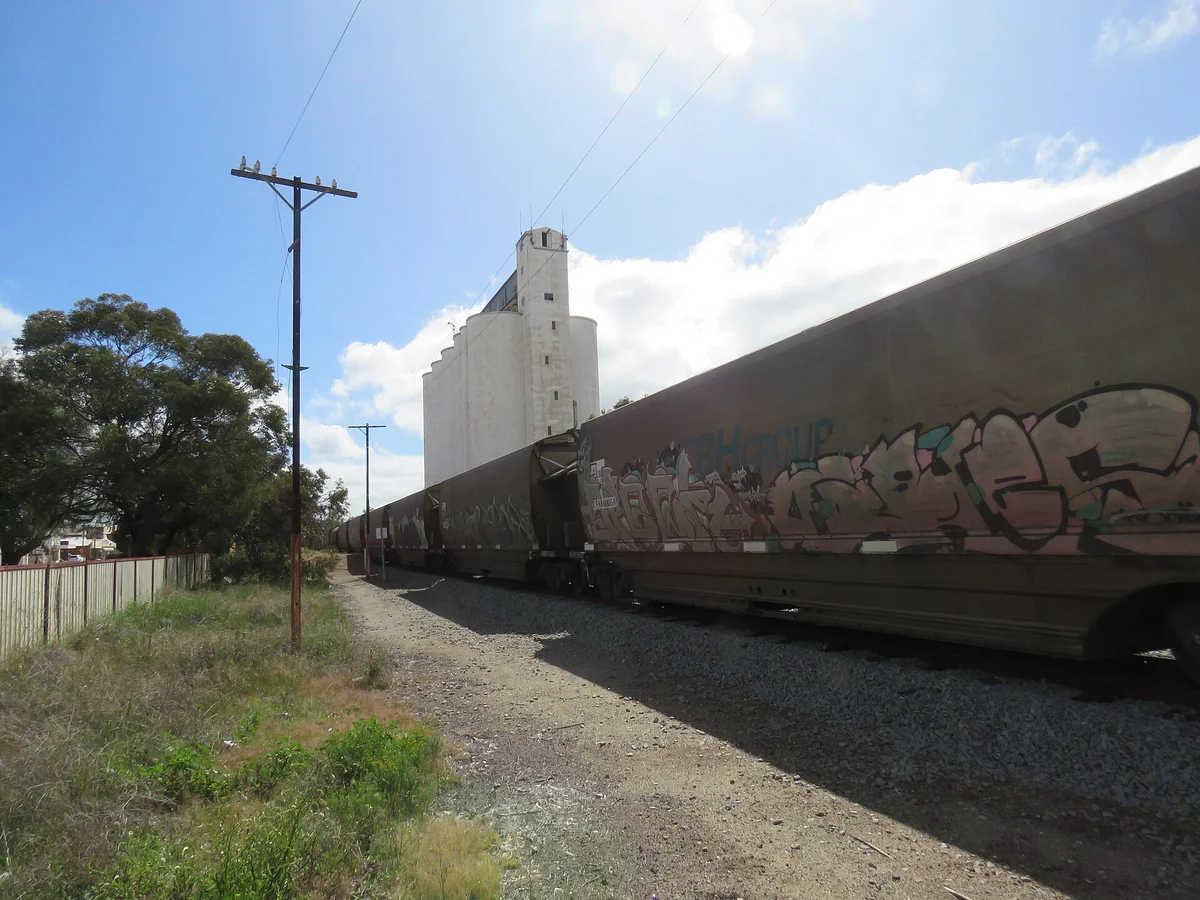
Photo: Calistemon via Wikimedia Commons (CC BY-SA 4.0). A grain train passing the receival point at Three Springs.
Comments